PRODUCT GUIDE
RAK CERAMICS | FALL WINTER COLLECTION 2022
TECHNICAL FEATURES
PORCELAIN TILES (BIa - GL) :
Porcelain tiles are manufactured using pure, selectively imported raw materials mixed using the most advanced
extraction and sorting techniques; they are obtained with a production process similar to that of single-fired tiles.
The resulting product is top-quality porcelain tile, obtained by raw materials wet grinding, followed by partial drying
by spraying, silo storage to allow homogenization of properties, and pressing with highly efficient hydraulic presses
up to specific pressures more than 500 kg/cm2. The high pressure combined with high firing temperature exceeding
1200 °C results in highly compact & strong ceramic surface with very low water absorption (lower than 0.1% according
to UNI EN ISO 10545-3) and extremely high mechanical resistance (average value exceeding 50 N/mm2 according to
UNI EN ISO 10545-4).
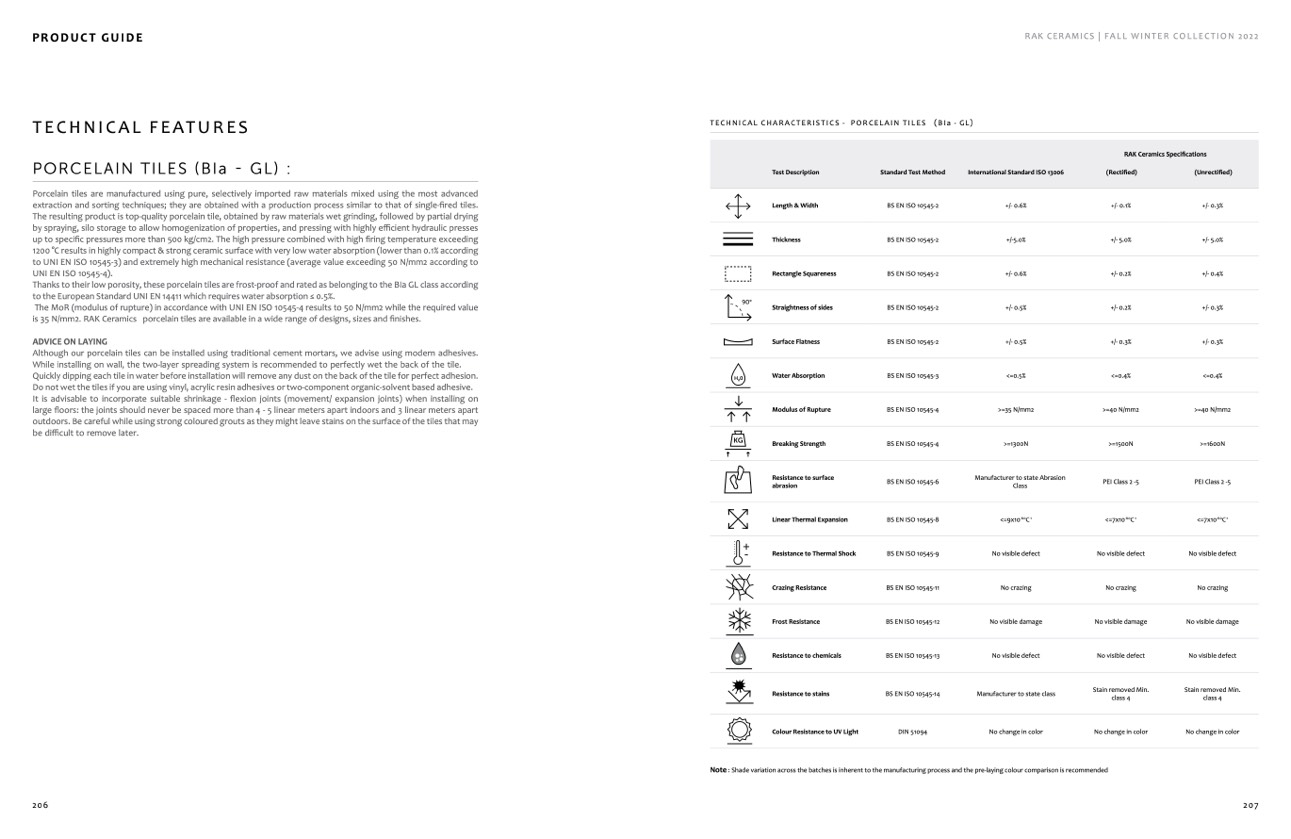
Thanks to their low porosity, these porcelain tiles are frost-proof and rated as belonging to the BIa GL class according
to the European Standard UNI EN 14411 which requires water absorption ≤ 0.5%.
The MoR (modulus of rupture) in accordance with UNI EN ISO 10545-4 results to 50 N/mm2 while the required value
is 35 N/mm2. RAK Ceramics porcelain tiles are available in a wide range of designs, sizes and finishes.
ADVICE ON LAYING
Although our porcelain tiles can be installed using traditional cement mortars, we advise using modern adhesives.
While installing on wall, the two-layer spreading system is recommended to perfectly wet the back of the tile.
Quickly dipping each tile in water before installation will remove any dust on the back of the tile for perfect adhesion.
Do not wet the tiles if you are using vinyl, acrylic resin adhesives or two-component organic-solvent based adhesive.
It is advisable to incorporate suitable shrinkage - flexion joints (movement/ expansion joints) when installing on
large floors: the joints should never be spaced more than 4 - 5 linear meters apart indoors and 3 linear meters apart
outdoors. Be careful while using strong coloured grouts as they might leave stains on the surface of the tiles that may
be difficult to remove later.
TECHNICAL CHARACTERISTICS - PORCELAIN TILES (BIa - GL)
Test Description
Standard Test Method
International Standard ISO 13006
RAK Ceramics
(Rectified)
Specifications
(Unrectified)
Length & Width
Thickness
Rectangle Squareness
Straightness of sides
Surface Flatness
Water Absorption
Modulus of Rupture
Breaking Strength
Resistance to surface
abrasion
Linear Thermal Expansion
Resistance to Thermal Shock
Crazing Resistance
Frost Resistance
Resistance to chemicals
Resistance to stains
Colour Resistance to UV Light
BS EN ISO 10545-2
BS EN ISO 10545-2
BS EN ISO 10545-2
BS EN ISO 10545-2
BS EN ISO 10545-2
BS EN ISO 10545-3
BS EN ISO 10545-4
BS EN ISO 10545-4
BS EN ISO 10545-6
BS EN ISO 10545-8
BS EN ISO 10545-9
BS EN ISO 10545-11
BS EN ISO 10545-12
BS EN ISO 10545-13
BS EN ISO 10545-14
DIN 51094
+/- 0.6%
+/-5.0%
+/- 0.6%
+/- 0.5%
+/- 0.5%
<=0.5%
>=35 N/mm2
>=1300N
Manufacturer to state Abrasion
Class
<=9x10
-60
C
-1
No visible defect
No crazing
No visible damage
No visible defect
Manufacturer to state class
No change in color
+/- 0.1%
+/- 5.0%
+/- 0.2%
+/- 0.2%
+/- 0.3%
<=0.4%
>=40 N/mm2
>=1500N
PEI Class 2 -5
<=7x10
-60
C
-1
No visible defect
No crazing
No visible damage
No visible defect
Stain removed Min.
class 4
No change in color
+/- 0.3%
+/- 5.0%
+/- 0.4%
+/- 0.3%
+/- 0.3%
<=0.4%
>=40 N/mm2
>=1600N
PEI Class 2 -5
<=7x10
-60
C
-1
No visible defect
No crazing
No visible damage
No visible defect
Stain removed Min.
class 4
No change in color
206
207
Note : Shade variation across the batches is inherent to the manufacturing process and the pre-laying colour comparison is recommended

