Too much office noise?
Office work always involves a trade-off between concentration and
communication. Acoustic screening and noise absorption can help deliver
constructive acoustic conditions in the work space. Here, we explain what
this means exactly:
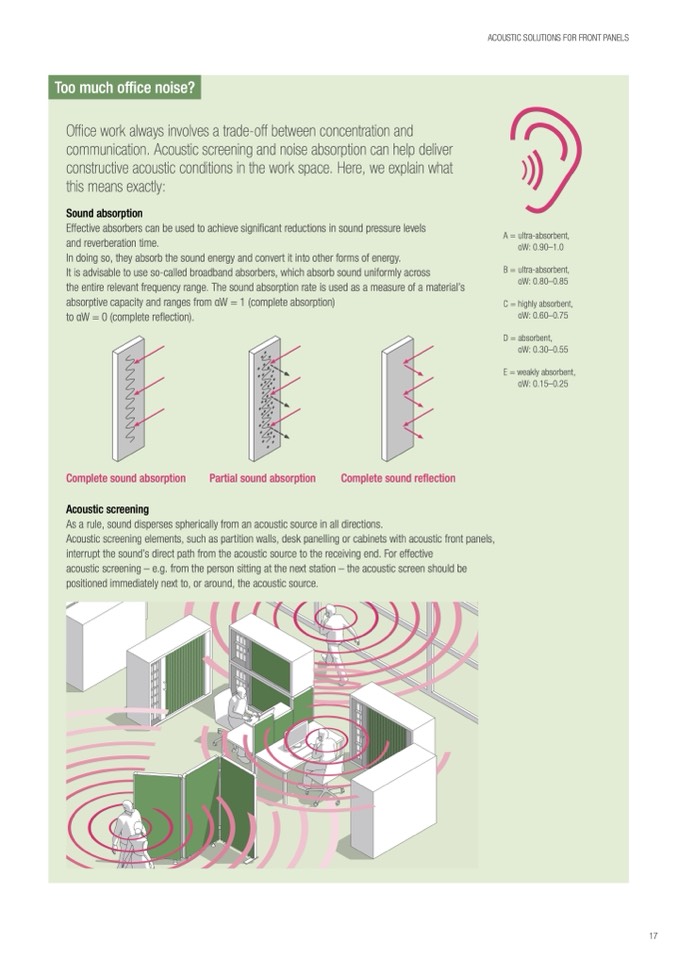
Sound absorption
Effective absorbers can be used to achieve significant reductions in sound pressure levels
and reverberation time.
In doing so, they absorb the sound energy and convert it into other forms of energy.
It is advisable to use so-called broadband absorbers, which absorb sound uniformly across
the entire relevant frequency range. The sound absorption rate is used as a measure of a material’s
absorptive capacity and ranges from αW = 1 (complete absorption)
A = ultra-absorbent,
αW: 0.90–1.0
B = ultra-absorbent,
αW: 0.80–0.85
C = highly absorbent,
αW: 0.60–0.75
D = absorbent,
αW: 0.30–0.55
E = weakly absorbent,
αW: 0.15–0.25
to αW = 0 (complete reflection).
Complete sound absorption
Acoustic screening
Partial sound absorption
Complete sound reflection
As a rule, sound disperses spherically from an acoustic source in all directions.
Acoustic screening elements, such as partition walls, desk panelling or cabinets with acoustic front panels,
interrupt the sound’s direct path from the acoustic source to the receiving end. For effective
acoustic screening – e.g. from the person sitting at the next station – the acoustic screen should be
positioned immediately next to, or around, the acoustic source.
ACOUSTIC SOLUTIONS FOR FRONT PANELS
17

