Mediterranean time off
Masseria Dagilupi Ostuni, Italy
Agape Destinations
“The choice of the Vieques collection was obvious
when it came to selecting a piece that could
exist in a white, mineral and stripped interior”.
Danielle and Jean Louis
90
91
EN
Puglia, the so-called ‘boot’ of the Italian peninsula
is known for its rolling fields of olive groves, picturesque,
whitewashed cities and an idyllic coastline of sandy beaches
and clear water that stretches as far as the eye can see.
It’s no wonder that it has become a coveted destination
for sun worshippers and lovers of all things ‘Dolce Vita’.
Masseria Dagilupi, a renovated traditional farmhouse near
Ostuni in the central part of the area, takes advantage
of all of the regions many gifts.
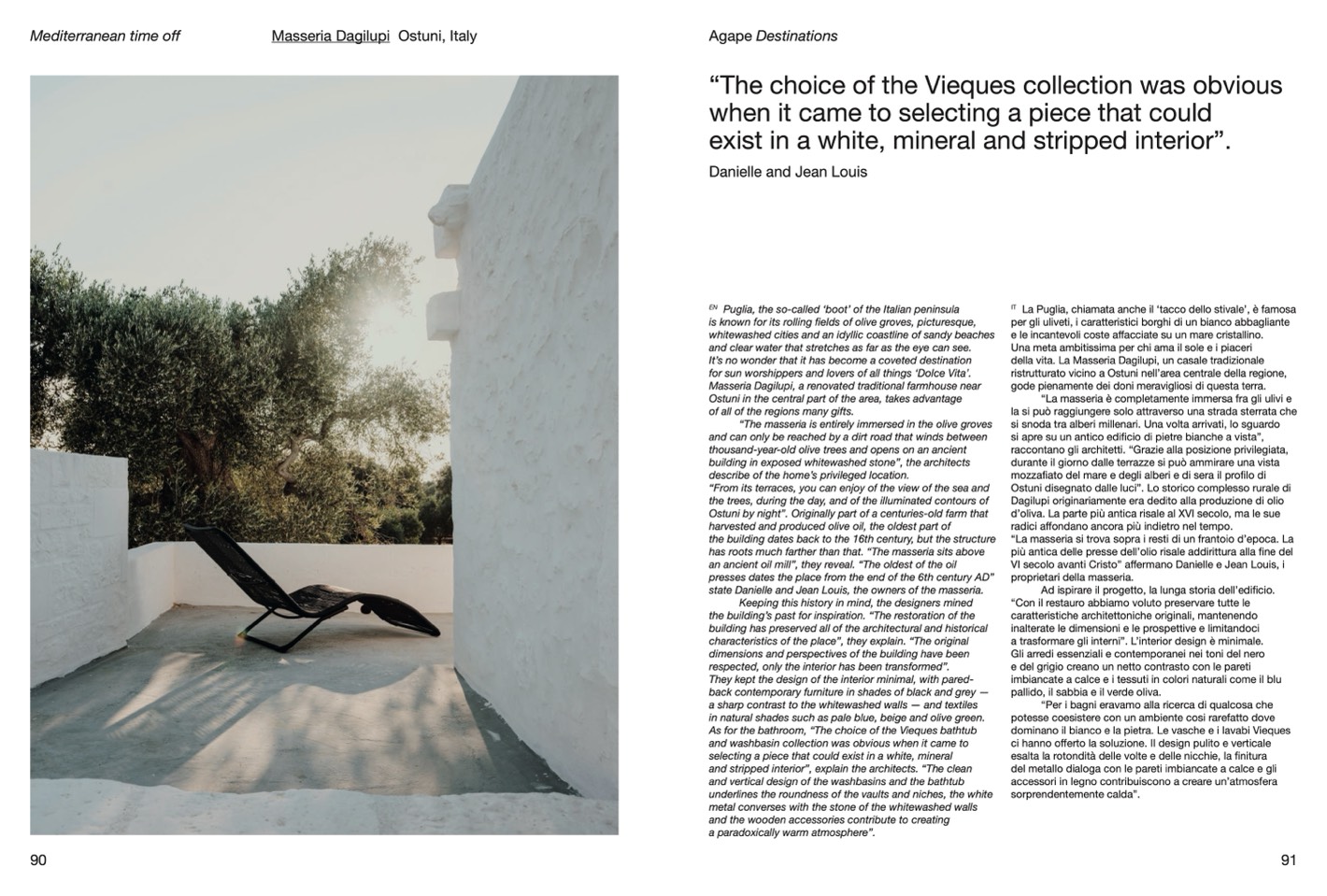
“The masseria is entirely immersed in the olive groves
and can only be reached by a dirt road that winds between
thousand-year-old olive trees and opens on an ancient
building in exposed whitewashed stone”, the architects
describe of the home’s privileged location.
“From its terraces, you can enjoy of the view of the sea and
the trees, during the day, and of the illuminated contours of
Ostuni by night”. Originally part of a centuries-old farm that
harvested and produced olive oil, the oldest part of
the building dates back to the 16th century, but the structure
has roots much farther than that. “The masseria sits above
an ancient oil mill”, they reveal. “The oldest of the oil
presses dates the place from the end of the 6th century AD”
state Danielle and Jean Louis, the owners of the masseria.
Keeping this history in mind, the designers mined
the building’s past for inspiration. “The restoration of the
building has preserved all of the architectural and historical
characteristics of the place”, they explain. “The original
dimensions and perspectives of the building have been
respected, only the interior has been transformed”.
They kept the design of the interior minimal, with pared-
back contemporary furniture in shades of black and grey —
a sharp contrast to the whitewashed walls — and textiles
in natural shades such as pale blue, beige and olive green.
As for the bathroom, “The choice of the Vieques bathtub
and washbasin collection was obvious when it came to
selecting a piece that could exist in a white, mineral
and stripped interior”, explain the architects. “The clean
and vertical design of the washbasins and the bathtub
underlines the roundness of the vaults and niches, the white
metal converses with the stone of the whitewashed walls
and the wooden accessories contribute to creating
a paradoxically warm atmosphere”.
IT
La Puglia, chiamata anche il ‘tacco dello stivale’, è famosa
per gli uliveti, i caratteristici borghi di un bianco abbagliante
e le incantevoli coste affacciate su un mare cristallino.
Una meta ambitissima per chi ama il sole e i piaceri
della vita. La Masseria Dagilupi, un casale tradizionale
ristrutturato vicino a Ostuni nell’area centrale della regione,
gode pienamente dei doni meravigliosi di questa terra.
“La masseria è completamente immersa fra gli ulivi e
la si può raggiungere solo attraverso una strada sterrata che
si snoda tra alberi millenari. Una volta arrivati, lo sguardo
si apre su un antico edificio di pietre bianche a vista”,
raccontano gli architetti. “Grazie alla posizione privilegiata,
durante il giorno dalle terrazze si può ammirare una vista
mozzafiato del mare e degli alberi e di sera il profilo di
Ostuni disegnato dalle luci”. Lo storico complesso rurale di
Dagilupi originariamente era dedito alla produzione di olio
d’oliva. La parte più antica risale al XVI secolo, ma le sue
radici affondano ancora più indietro nel tempo.
“La masseria si trova sopra i resti di un frantoio d’epoca. La
più antica delle presse dell’olio risale addirittura alla fine del
VI secolo avanti Cristo” affermano Danielle e Jean Louis, i
proprietari della masseria.
Ad ispirare il progetto, la lunga storia dell’edificio.
“Con il restauro abbiamo voluto preservare tutte le
caratteristiche architettoniche originali, mantenendo
inalterate le dimensioni e le prospettive e limitandoci
a trasformare gli interni”. L’interior design è minimale.
Gli arredi essenziali e contemporanei nei toni del nero
e del grigio creano un netto contrasto con le pareti
imbiancate a calce e i tessuti in colori naturali come il blu
pallido, il sabbia e il verde oliva.
“Per i bagni eravamo alla ricerca di qualcosa che
potesse coesistere con un ambiente cosi rarefatto dove
dominano il bianco e la pietra. Le vasche e i lavabi Vieques
ci hanno offerto la soluzione. Il design pulito e verticale
esalta la rotondità delle volte e delle nicchie, la finitura
del metallo dialoga con le pareti imbiancate a calce e gli
accessori in legno contribuiscono a creare un’atmosfera
sorprendentemente calda”.

