Remarkable cities
The Venice Venice Hotel Venezia, Italy
Agape Destinations
EN
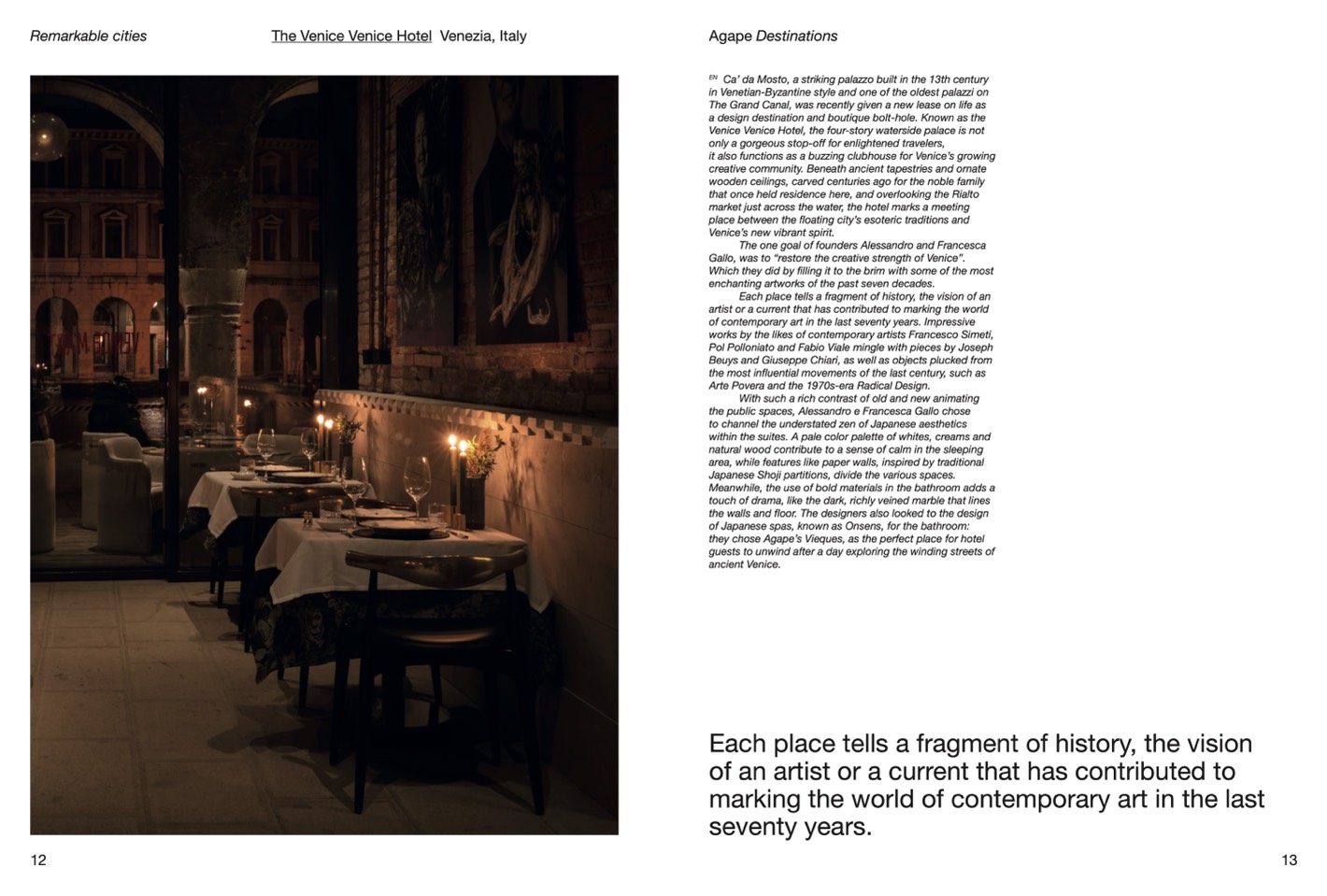
Ca’ da Mosto, a striking palazzo built in the 13th century
in Venetian-Byzantine style and one of the oldest palazzi on
The Grand Canal, was recently given a new lease on life as
a design destination and boutique bolt-hole. Known as the
Venice Venice Hotel, the four-story waterside palace is not
only a gorgeous stop-off for enlightened travelers,
it also functions as a buzzing clubhouse for Venice’s growing
creative community. Beneath ancient tapestries and ornate
wooden ceilings, carved centuries ago for the noble family
that once held residence here, and overlooking the Rialto
market just across the water, the hotel marks a meeting
place between the floating city’s esoteric traditions and
Venice’s new vibrant spirit.
The one goal of founders Alessandro and Francesca
Gallo, was to “restore the creative strength of Venice”.
Which they did by filling it to the brim with some of the most
enchanting artworks of the past seven decades.
Each place tells a fragment of history, the vision of an
artist or a current that has contributed to marking the world
of contemporary art in the last seventy years. Impressive
works by the likes of contemporary artists Francesco Simeti,
Pol Polloniato and Fabio Viale mingle with pieces by Joseph
Beuys and Giuseppe Chiari, as well as objects plucked from
the most influential movements of the last century, such as
Arte Povera and the 1970s-era Radical Design.
With such a rich contrast of old and new animating
the public spaces, Alessandro e Francesca Gallo chose
to channel the understated zen of Japanese aesthetics
within the suites. A pale color palette of whites, creams and
natural wood contribute to a sense of calm in the sleeping
area, while features like paper walls, inspired by traditional
Japanese Shoji partitions, divide the various spaces.
Meanwhile, the use of bold materials in the bathroom adds a
touch of drama, like the dark, richly veined marble that lines
the walls and floor. The designers also looked to the design
of Japanese spas, known as Onsens, for the bathroom:
they chose Agape’s Vieques, as the perfect place for hotel
guests to unwind after a day exploring the winding streets of
ancient Venice.
12
13
Each place tells a fragment of history, the vision
of an artist or a current that has contributed to
marking the world of contemporary art in the last
seventy years.

