the environment.
Operation
The active sludge biological process refers to a type of aerobic
treatment conducted by aeration of the wastewater in a biological
reactor in the presence of a microbial population (biomass). In
activated sludge plants, the bacterial populations, constituted
by numerous microorganisms, are produced continuously within
the reactor following the biochemical reactions of degradation of
organic carbon and nutrient utilization, resulting in the synthesis
of new cellular material. The activated sludge plants are equipped
with blowers that increase the presence of oxygen inside them
thereby increasing the capacity of the degradation of the organic
load by aerobic bacteria. In fact, these bacteria exploit the
oxygen to consume the biodegradable material, and the greater
the presence of oxygen, the greater is the ability to “consume”
the biodegradable organic material inside the tanks. Low Load
activated sludge plants are designed for volume not exceeding 0.5
(Cv < 0.5 BOD / m
3
) and daily organic volume not exceeding 48
g/ P.E. The low-load activated sludge plants are equipped with
internal sedimentation tank to separate the purified effluent from
the activated sludge that will accumulate in the digester.
Maintenance
For the correct management of the FBC and to achieve the
required purification results, please follow these guidelines:
•
Regularly inspect the FBC to check that there is no gross
material received accidentally to clog the pipes;
•
Regularly check that no anomalies have occurred to the
electrical panel if present;
•
Verify that the diaphragm blower works properly, that is,
movement must be observed in the volume of oxidation
coinciding with the operating time;
•
Every six months carry out the removal of excess sludge.
Such removal must be carried out by a specialized company;
Specification Item
The activated sludge purification unit for secondary treatment of
residential wastewater manufactured in rotational polyethylene, in
a single structure, free of joints and with reinforcement plate, and
equipped with inlet and outlet holes, a sedimentation chamber,
a digestion tank and inspection and sampling lids. Suitable for
underground installation. The system must be equipped with blower
and micro-bubbles diffuser, according to the plant specifications.
The low-load activated sludge treatment plant has been designed in
compliance with the indications given by experience, in particular, it
has a retention time in the treatment stage of approximately 22 hours
and the indications summarised below:
RESIDENTIAL WASTEWATER
SECONDARY TREATMENT - DRAIN TO WATERCOURSES
Use
•
Secondary treatment of residential black water.
Low-load activated sludge treatment plants are to be installed
downstream of the Imhoff tank to allow the drain of purified water
directly into a surface watercourse, without the risk of polluting
As provided for by the Consolidated Act on Water (Legislative
Decree 152/06 as amended), and suggested by the normal
hygiene practice, periodically inspect and wash the inspection
well.
PROJECT PARAMETERS
Water supply per P.E.
lt/d
200
Average flow (Q24) per P.E.
lt/h
8,3
Peak flow (Qp) per P.E.
lt/h
20
Specific organic load
gr BOD
5
/P.E.x d
42
Concentration of the biodegradable fraction
mg/l
240
COD/BOD
5
1,67-2,2
Total daily nitrogen load per P.E.
kg/P.E.x d
<0,012
Total surfactant concentration
mg/l
<15
Concentration of oils and fats
mg/l
<10
Retention time in the treatment stage
h
22 c.a
Air flow supplied to the process per P.E.
m
3
/h
0,45
Oxygen fed to the system per P.E.
m
3
/h
0,09
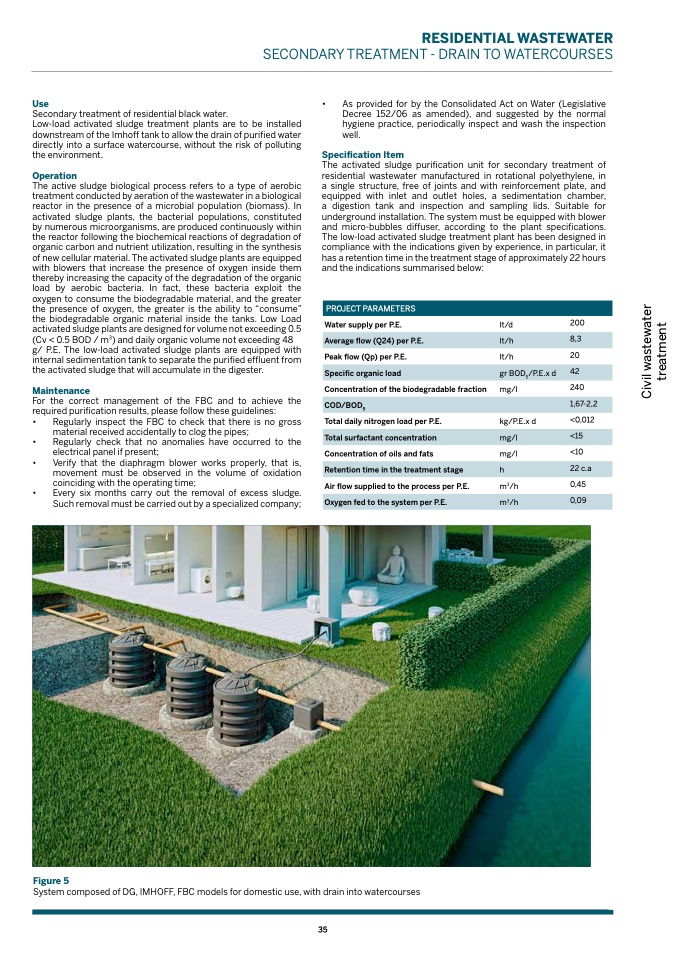
Figure 5
System composed of DG, IMHOFF, FBC models for domestic use, with drain into watercourses
35
C
i
v
i
l
w
a
s
t
e
w
a
t
e
r
t
r
e
a
t
m
e
n
t

