RESIDENTIAL WASTEWATER
SECONDARY TREATMENT - DRAIN TO THE GROUND
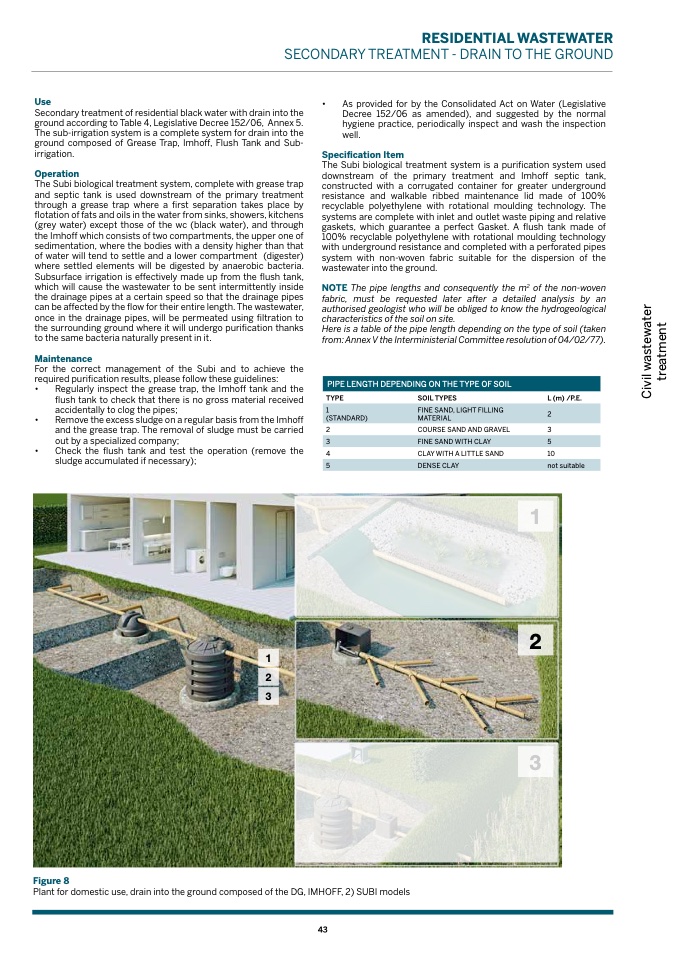
Use
Secondary treatment of residential black water with drain into the
ground according to Table 4, Legislative Decree 152/06, Annex 5.
The sub-irrigation system is a complete system for drain into the
ground composed of Grease Trap, Imhoff, Flush Tank and Sub-
irrigation.
Operation
The Subi biological treatment system, complete with grease trap
and septic tank is used downstream of the primary treatment
through a grease trap where a first separation takes place by
flotation of fats and oils in the water from sinks, showers, kitchens
(grey water) except those of the wc (black water), and through
the Imhoff which consists of two compartments, the upper one of
sedimentation, where the bodies with a density higher than that
of water will tend to settle and a lower compartment (digester)
where settled elements will be digested by anaerobic bacteria.
Subsurface irrigation is effectively made up from the
flush tank,
which will cause the wastewater to be sent intermittently inside
the drainage pipes at a certain speed so that the drainage pipes
can be affected by the flow for their entire length. The wastewater,
once in the drainage pipes, will be permeated using filtration to
the surrounding ground where it will undergo purification thanks
to the same bacteria naturally present in it.
Maintenance
For the correct management of the Subi and to achieve the
required purification results, please follow these guidelines:
•
Regularly inspect the grease trap, the Imhoff tank and the
flush tank to check that there is no gross material received
accidentally to clog the pipes;
•
Remove the excess sludge on a regular basis from the Imhoff
and the grease trap. The removal of sludge must be carried
out by a specialized company;
•
Check the flush tank and test the operation (remove the
sludge accumulated if necessary);
•
As provided for by the Consolidated Act on Water (Legislative
Decree 152/06 as amended), and suggested by the normal
hygiene practice, periodically inspect and wash the inspection
well.
Specification Item
The Subi biological treatment system is a purification system used
downstream of the primary treatment and Imhoff septic tank,
constructed with a corrugated container for greater underground
resistance and walkable ribbed maintenance lid made of 100%
recyclable polyethylene with rotational moulding technology. The
systems are complete with inlet and outlet waste piping and relative
gaskets, which guarantee a perfect Gasket. A flush tank made of
100% recyclable polyethylene with rotational moulding technology
with underground resistance and completed with a perforated pipes
system with non-woven fabric suitable for the dispersion of the
wastewater into the ground.
NOTE The pipe lengths and consequently the m
2
of the non-woven
fabric, must be requested later after a detailed analysis by an
authorised geologist who will be obliged to know the hydrogeological
characteristics of the soil on site.
Here is a table of the pipe length depending on the type of soil (taken
from: Annex V the Interministerial Committee resolution of 04/02/77).
PIPE LENGTH DEPENDING ON THE TYPE OF SOIL
TYPE
SOIL TYPES
L (m) /P.E.
1
(STANDARD)
FINE SAND, LIGHT FILLING
MATERIAL
2
2
COURSE SAND AND GRAVEL
3
3
FINE SAND WITH CLAY
5
4
CLAY WITH A LITTLE SAND
10
5
DENSE CLAY
not suitable
1
2
3
1
2
3
Figure 8
Plant for domestic use, drain into the ground composed of the DG, IMHOFF, 2) SUBI models
43
C
i
v
i
l
w
a
s
t
e
w
a
t
e
r
t
r
e
a
t
m
e
n
t

