08
RACCORDI A PRESSARE PER TUBO PEX “COBRAPEX“
PRESS-FITTINGS FOR PEX PIPE “COBRAPEX“
ISTRUZIONI PER IL CORRETTO MONTAGGIO DAL Ø12 AL Ø32
INSTRUCTIONS FOR THE CORRECT ASSEMBLING FROM Ø12 TO Ø32
1
2
3
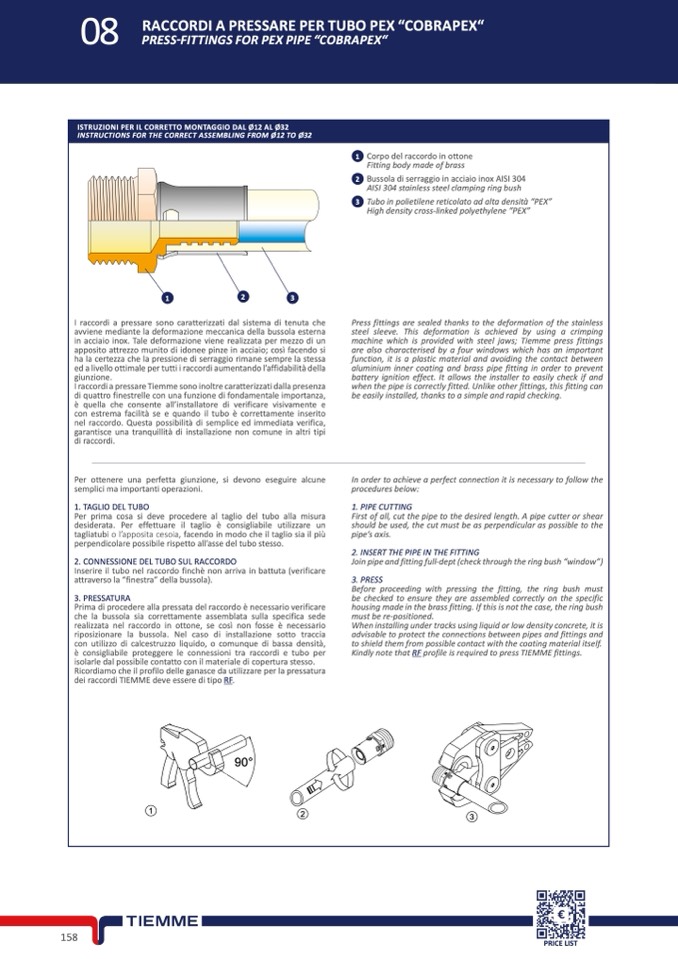
I raccordi a pressare sono caratterizzati dal sistema di tenuta che
avviene mediante la deformazione meccanica della bussola esterna
in acciaio inox. Tale deformazione viene realizzata per mezzo di un
apposito attrezzo munito di idonee pinze in acciaio; così facendo si
ha la certezza che la pressione di serraggio rimane sempre la stessa
ed a livello ottimale per tutti i raccordi aumentando l’affidabilità della
giunzione.
1 Corpo del raccordo in ottone
Fitting body made of brass
2 Bussola di serraggio in acciaio inox AISI 304
AISI 304 stainless steel clamping ring bush
3 Tubo in polietilene reticolato ad alta densità “PEX”
High density cross-linked polyethylene “PEX”
Press fittings are sealed thanks to the deformation of the stainless
steel sleeve. This deformation is achieved by using a crimping
machine which is provided with steel jaws; Tiemme press fittings
are also characterised by a four windows which has an important
function, it is a plastic material and avoiding the contact between
aluminium inner coating and brass pipe fitting in order to prevent
battery ignition effect. It allows the installer to easily check if and
when the pipe is correctly fitted. Unlike other fittings, this fitting can
be easily installed, thanks to a simple and rapid checking.
In order to achieve a perfect connection it is necessary to follow the
procedures below:
First of all, cut the pipe to the desired length. A pipe cutter or shear
should be used, the cut must be as perpendicular as possible to the
pipe’s axis.
I raccordi a pressare Tiemme sono inoltre caratterizzati dalla presenza
di quattro finestrelle con una funzione di fondamentale importanza,
è quella che consente all’installatore di verificare visivamente e
con estrema facilità se e quando il tubo è correttamente inserito
nel raccordo. Questa possibilità di semplice ed immediata verifica,
garantisce una tranquillità di installazione non comune in altri tipi
di raccordi.
Per ottenere una perfetta giunzione, si devono eseguire alcune
semplici ma importanti operazioni.
Per prima cosa si deve procedere al taglio del tubo alla misura
desiderata. Per effettuare il taglio
è consigliabile utilizzare un
tagliatubi o l’apposita cesoia, facendo in modo che il taglio sia il pi
ù
perpendicolare possibile rispetto all’asse del tubo stesso.
1. TAGLIO DEL TUBO
1. PIPE CUTTING
2. CONNESSIONE DEL TUBO SUL RACCORDO
2. INSERT THE PIPE IN THE FITTING
Inserire il tubo nel raccordo finchè non arriva in battuta (verificare
attraverso la “finestra” della bussola).
Join pipe and fitting full-dept (check through the ring bush “window”)
3. PRESSATURA
Prima di procedere alla pressata del raccordo
è necessario verificare
che la bussola sia correttamente assemblata sulla specifica sede
realizzata nel raccordo in ottone, se cos
ì non fosse
è necessario
riposizionare la bussola. Nel caso di installazione sotto traccia
con utilizzo di calcestruzzo liquido, o comunque di bassa densit
à,
è consigliabile proteggere le connessioni tra raccordi e tubo per
isolarle dal possibile contatto con il materiale di copertura stesso.
Ricordiamo che il profilo delle ganasce da utilizzare per la pressatura
dei raccordi TIEMME deve essere di tipo RF.
Before proceeding with pressing the fitting, the ring bush must
be checked to ensure they are assembled correctly on the specific
housing made in the brass fitting. If this is not the case, the ring bush
must be re-positioned.
3. PRESS
When installing under tracks using liquid or low density concrete, it is
advisable to protect the connections between pipes and fittings and
to shield them from possible contact with the coating material itself.
Kindly note that RF profile is required to press TIEMME fittings.
1
90°
2
3
158
PRICE LIST

