Legionella a “dangerous” bacteria
In fact, the bacteria enters the body through the
airways by inhalation or aspiration of aerosols. The
smaller the water drops the greater the amount
of germs that can easily reach the lower respira-
tory tract, especially the lungs. Aerosols can come
from various sources: the opening of a water tap or
shower of a contaminated water system, whirlpool
bathtubs and swimming pools; Turkish baths and
sauna; ornamental fountains especially if placed
indoors; garden irrigation systems, sanitary wa-
stewater, cooling towers and evaporative coolers,
and air-conditioning systems in general. The latter,
in places where they have been installed, create a
real Legionella risk if they do not receive adequate
and regular maintenance.
Legionella and current legislation
Italian law regulated the Legionella subject with
a series of official guidelines. These concern the
prevention and control of Legionella infection, in-
dications for managers of tourist and spa facilities,
indications for microbiological diagnosis and envi-
ronmental control laboratories.
The Ministry of Health drafted these guidelines for
the first time in May 2000: they were the first natio-
nal document of legislation on Legionella, aimed at
providing health workers with information updated
on Legionella infection, various sources of infection,
diagnostic methods and epidemiological and envi-
ronmental investigations.
The regulatory framework refers to the following
evidence, to which legionella legislation 2018 and
following are:
• Legislative Decree 81/08, “Consolidated Text on
Health and Safety at Work”, offers information on
the guarantee of hygiene of the workplace and wor-
kers’ health.
Regarding Legionella infection, it is the same law
text to establish guidelines for prevention and con-
trol, and the measures to be taken for the control of
legionella in the workplace.
• State-Regions Agreement 2013 and 2015 (79/
CSR of 07/05/2015) integrates the indications of
the previous national guidelines (‘Guidelines for the
prevention and control of Legionella infections, G.U.
5 May 2000; “Guidelines containing indications on
legionella infection for managers of tourist and spa
facilities” and “Guidelines containing indications to
laboratories with activities of microbiological dia-
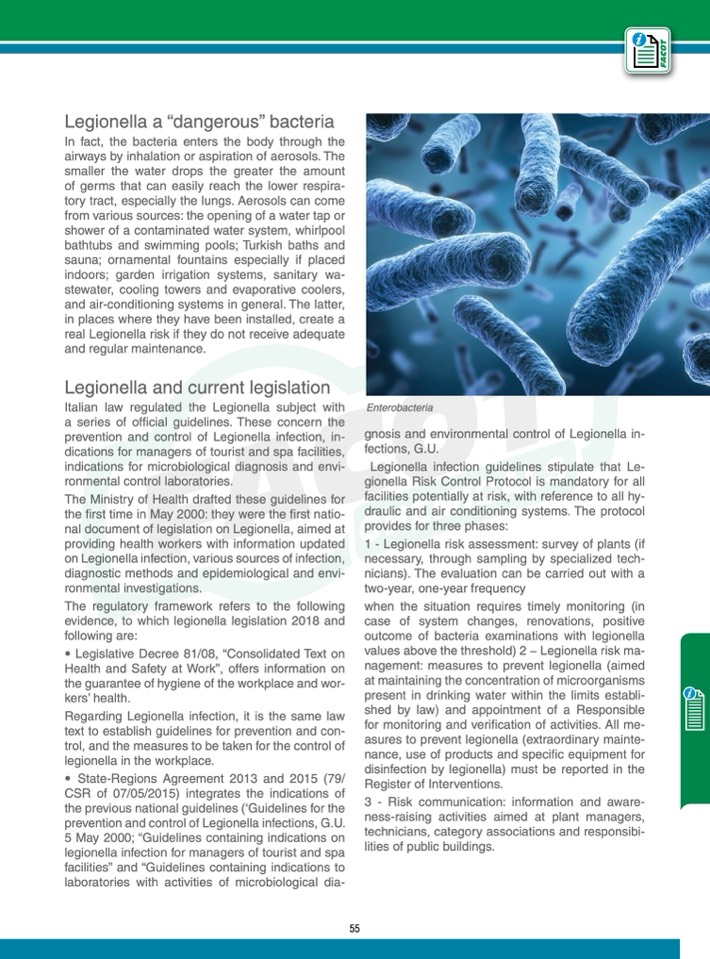
Enterobacteria
gnosis and environmental control of Legionella in-
fections, G.U.
Legionella infection guidelines stipulate that Le-
gionella Risk Control Protocol is mandatory for all
facilities potentially at risk, with reference to all hy-
draulic and air conditioning systems. The protocol
provides for three phases:
1 - Legionella risk assessment: survey of plants (if
necessary, through sampling by specialized tech-
nicians). The evaluation can be carried out with a
two-year, one-year frequency
when the situation requires timely monitoring (in
case of system changes, renovations, positive
outcome of bacteria examinations with legionella
values above the threshold) 2 − Legionella risk ma-
nagement: measures to prevent legionella (aimed
at maintaining the concentration of microorganisms
present in drinking water within the limits establi-
shed by law) and appointment of a Responsible
for monitoring and verification of activities. All me-
asures to prevent legionella (extraordinary mainte-
nance, use of products and specific equipment for
disinfection by legionella) must be reported in the
Register of Interventions.
3 - Risk communication: information and aware-
ness-raising activities aimed at plant managers,
technicians, category associations and responsibi-
lities of public buildings.
55

