PRODUCT GUIDE
RAK CERAMICS | FALL WINTER COLLECTION 2022
TECHNICAL FEATURES
RED BODY CERAMIC TILES (BIII):
Red body Ceramic tiles are made with finest quality clays and with chamotte (a ceramic raw material with high
percentage of silica). These raw materials are submitted to dry grinding and suitably mixed and wet and then pressed
with hydraulic presses. Quick-cycle support firing is obtained via roller kilns reaching temperatures of approximately
1100 °C. After biscuit glazing, the vitrified product is sintered in a single-layer roller kiln at approximately 1030 °C.
The resulting wall tiles have an average bending strength that is higher than 15/ mrre in accordance with the UNI
EN ISO10545-4 standard and a water absorption level that is higher than 10 %; they belong to the Blll (GL) group
according to the UNI EN 14411 standard. This class of products shows virtually no shrinkage during firing; therefore
such dimensional consistency results in extremely easy laying.
ADVICE ON LAYING
Ceramic Red body tiles can be laid using either tile adhesives or cement mortar. Under no circumstances should the
tiles be wet before laying when using acrylic or vinyl resin based adhesives or two- component organic solvent based
adhesives. When laying large sized tiles it is best to adopt the two layer spreading method and, when the laying
surface is very large, to provide for suitable expansion joints which must not be spaced more than 4-5 linear meters
apart from one another.
IMPORTANT POINTS TO REMEMBER WHILE LAYING THESE TILES
When laying on wet concrete or plaster, leave to dry for at least one week for each centimetre of thickness.
When laying on brick, never lay on tile adhesive measuring more than 4-5 mm in thickness. For laying on flexible
supports (for example plasterboard panels, polymer panels, etc.) which may result in movement of the tiles, we
advise laying on tile adhesive measuring no more than 2-3 mm in thickness and to use class C2 or D1 glues.
For laying on waterproof brick, which prevents the release of damp, we advise laying on tile adhesive measuring no
more than 3 mm in thickness and to use class C2 or D1 glues.
Avoid laying without expansion joints or joints where stress due to expansion is released directly onto the tile.
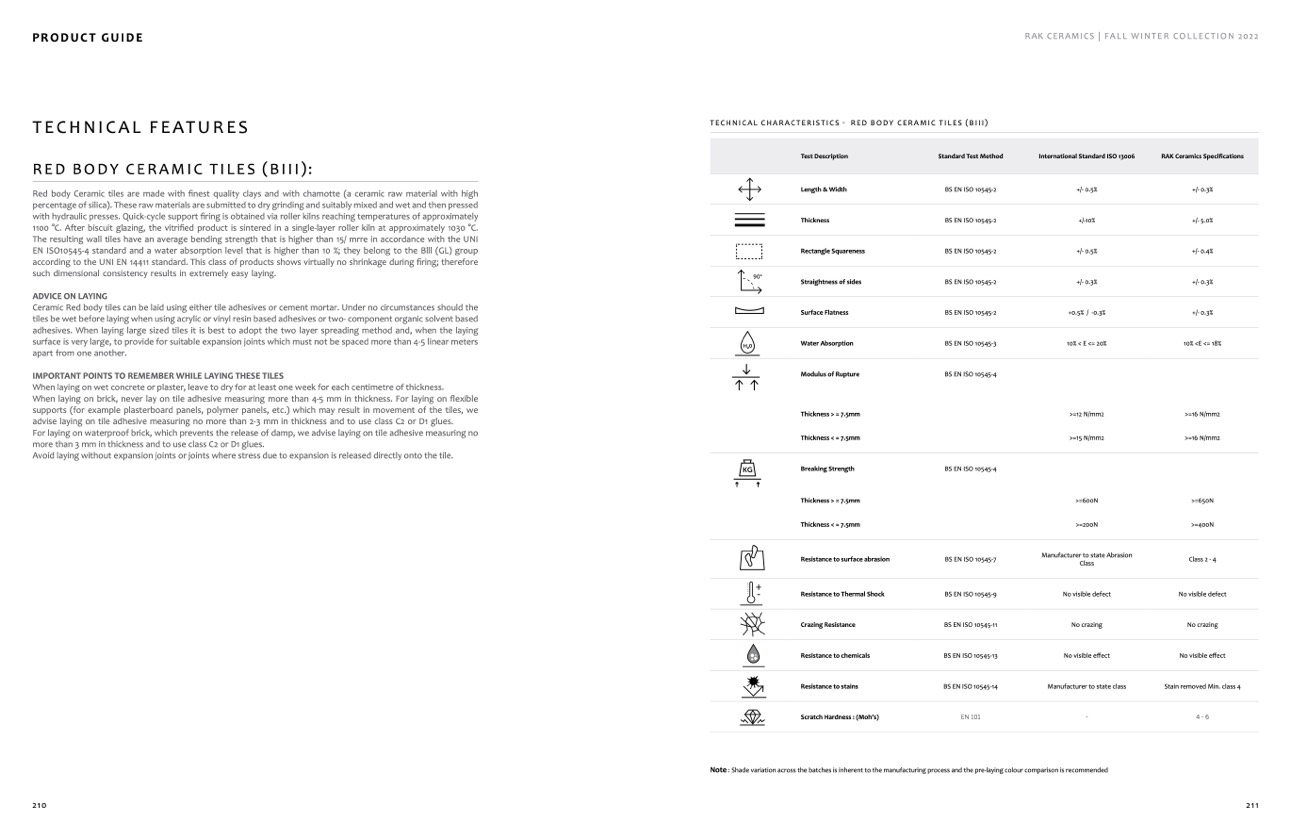
TECHNICAL CHARACTERISTICS - RED BODY CERAMIC TILES (BIII)
Test Description
Standard Test Method
International Standard ISO 13006
RAK Ceramics Specifications
Length & Width
Thickness
Rectangle Squareness
Straightness of sides
Surface Flatness
Water Absorption
Modulus of Rupture
Thickness > = 7.5mm
Thickness < = 7.5mm
Breaking Strength
Thickness > = 7.5mm
Thickness < = 7.5mm
Resistance to surface abrasion
Resistance to Thermal Shock
Crazing Resistance
Resistance to chemicals
Resistance to stains
Scratch Hardness : (Moh’s)
BS EN ISO 10545-2
BS EN ISO 10545-2
BS EN ISO 10545-2
BS EN ISO 10545-2
BS EN ISO 10545-2
BS EN ISO 10545-3
BS EN ISO 10545-4
BS EN ISO 10545-4
BS EN ISO 10545-7
BS EN ISO 10545-9
BS EN ISO 10545-11
BS EN ISO 10545-13
BS EN ISO 10545-14
EN 101
+/- 0.5%
+/-10%
+/- 0.5%
+/- 0.3%
+0.5% / -0.3%
10% < E <= 20%
>=12 N/mm2
>=15 N/mm2
>=600N
>=200N
Manufacturer to state Abrasion
Class
No visible defect
No crazing
No visible effect
Manufacturer to state class
-
+/- 0.3%
+/- 5.0%
+/- 0.4%
+/- 0.3%
+/- 0.3%
10% <E <= 18%
>=16 N/mm2
>=16 N/mm2
>=650N
>=400N
Class 2 - 4
No visible defect
No crazing
No visible effect
Stain removed Min. class 4
4 - 6
210
211
Note : Shade variation across the batches is inherent to the manufacturing process and the pre-laying colour comparison is recommended

