RISCALDATORI AD OLIO DIATERMICO | DIATHERMIC OIL HEATERS
ELICOIL NO
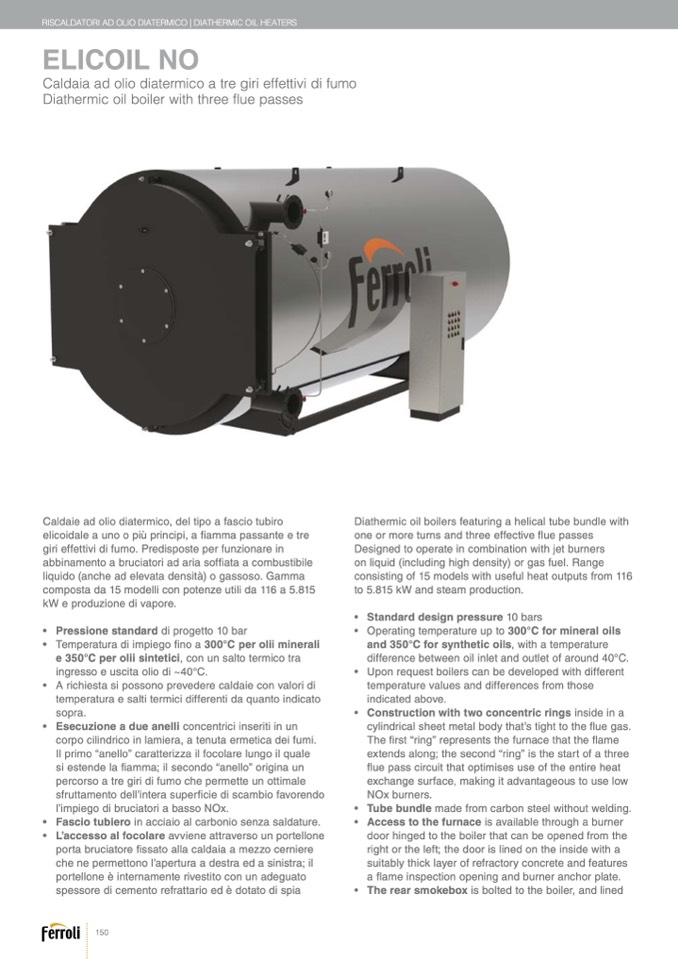
Caldaia ad olio diatermico a tre giri effettivi di fumo
Diathermic oil boiler with three flue passes
Caldaie ad olio diatermico, del tipo a fascio tubiro
elicoidale a uno o pi
ù principi, a
fiamma passante e tre
giri effettivi di fumo. Predisposte per funzionare in
abbinamento a bruciatori ad aria soffiata a combustibile
liquido (anche ad elevata densità) o gassoso. Gamma
composta da 15 modelli con potenze utili da 116 a 5.815
kW e produzione di vapore.
• Pressione standard di progetto 10 bar
• Temperatura di impiego fino a 300°C per olii minerali
e 350°C per olii sintetici, con un salto termico tra
ingresso e uscita olio di ~40°C.
• A richiesta si possono prevedere caldaie con valori di
temperatura e salti termici differenti da quanto indicato
sopra.
• Esecuzione a due anelli concentrici inseriti in un
corpo cilindrico in lamiera, a tenuta ermetica dei fumi.
Il primo “anello” caratterizza il focolare lungo il quale
si estende la
fiamma; il secondo “anello” origina un
percorso a tre giri di fumo che permette un ottimale
sfruttamento dell’intera superficie di scambio favorendo
l’impiego di bruciatori a basso NOx.
• Fascio tubiero in acciaio al carbonio senza saldature.
• L’accesso al focolare avviene attraverso un portellone
porta bruciatore
fissato alla caldaia a mezzo cerniere
che ne permettono l’apertura a destra ed a sinistra; il
portellone
è internamente rivestito con un adeguato
spessore di cemento refrattario ed è dotato di spia
Diathermic oil boilers featuring a helical tube bundle with
one or more turns and three effective flue passes
Designed to operate in combination with jet burners
on liquid (including high density) or gas fuel. Range
consisting of 15 models with useful heat outputs from 116
to 5.815 kW and steam production.
• Standard design pressure 10 bars
• Operating temperature up to 300°C for mineral oils
and 350°C for synthetic oils, with a temperature
difference between oil inlet and outlet of around 40°C.
• Upon request boilers can be developed with different
temperature values and differences from those
indicated above.
• Construction with two concentric rings inside in a
cylindrical sheet metal body that’s tight to the
flue gas.
The first “ring” represents the furnace that the
flame
extends along; the second “ring” is the start of a three
flue pass circuit that optimises use of the entire heat
exchange surface, making it advantageous to use low
NOx burners.
• Tube bundle made from carbon steel without welding.
• Access to the furnace is available through a burner
door hinged to the boiler that can be opened from the
right or the left; the door is lined on the inside with a
suitably thick layer of refractory concrete and features
a
flame inspection opening and burner anchor plate.
• The rear smokebox is bolted to the boiler, and lined
150

