Chemical and Physical Treatments, what to do
The water, whether it comes from the aqueduct,
either from wellspring stratum, contains a variety
of minerals. In particular the carbonates of calcium
and magnesium, also called salts of hardness. The
amount of such salts dissolved in water determines
its hardness, measured in parts per million (ppm)
of calcium carbonate, or more commonly in French
degrees (°f), where 10 ppm of CaCO
3
equivalent
to 1 °f. The salts of calcium and magnesium, with
heat are transformed into carbonates and precipi-
tate forming the incrustation commonly called lime-
stone. This happens already at around 35 - 40 °C.
The limestone is a very bad conductor of heat and
therefore an excellent thermal insulator, this means
that where there are deposits will be required more
and more electrical or thermal energy to heat the
water at the desired temperature. The scaling in pi-
pes then decrease the useful space for the transit of
water and may also cause a punctiform corrosion,
the worst one because it obliges the replacement
or repair of pipes, and bring also obstruction da-
mages caused to valves, pumps, mixers, shower
heads, etc. The solution to all these problems is the
reduction of hardness, this means the softening or
water conditioning as prescribed by DM 26/2015.
For many years, there is a widespread technique
to add specific chemicals to drinking water for the
protection of water systems against corrosion and
limescale , among them has caught the use of
proportional dosing of polyphosphate. In fact, the
polyphosphate is combined with the hardness of
the water and prevents the precipitation (in par-
ticular when the water is heated in boilers, water
heaters , washing machines, dishwashers, etc.),
thus avoiding the formation of scale, which de-
termine the loss of efficiency of heating systems
and high energy consumption. The polyphosphate
also professes a protective function by exerting an
anticorrosion action. The dosage of polyphospha-
te diffused on the market in various forms inclu-
ding powder, crystals, liquid refills, it is generally
made with two types of systems: proportional and
non-proportional.
The quantity of polyphosphates dosed into the wa-
ter from a non-proportional system does not de-
pend from the flow or from the consumption. On
the contrary, proportional systems dose a quantity
of polyphosphates into the water proportional to
the flow and consumption, being particularly indi-
cated for the treatment of water intended for human
consumption. In particular, systems with polypho-
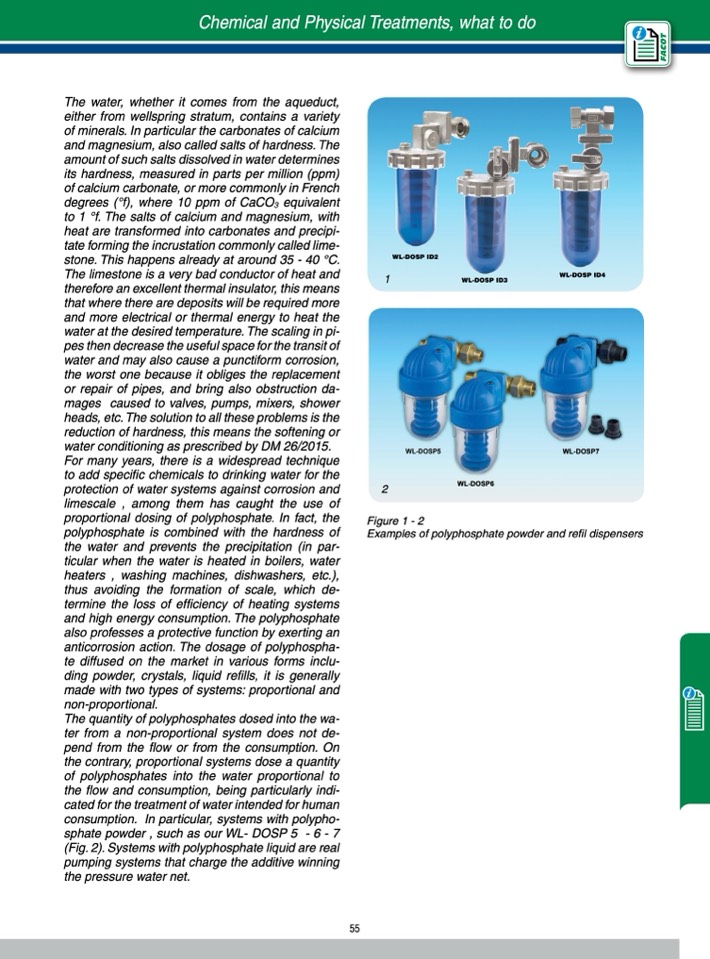
sphate powder , such as our WL- DOSP 5 - 6 - 7
(Fig. 2). Systems with polyphosphate liquid are real
pumping systems that charge the additive winning
the pressure water net.
WL-doSP Id2
1
WL-doSP Id3
WL-doSP Id4
2
Figure 1 - 2
Examples of polyphosphate powder and refil dispensers
55

