Chemical and Physical Treatments, what to do
In addition, we will take care to verify by means
of the HARDNESS KIT the total hardness of the
water used for the loading of the system which,
as required by the UNI 8065 concerning the “Tre-
atment of water in heating systems for civil use”,
should never exceed 15 °f to avoid problems re-
lated to the precipitation of limestone; otherwise
the law requires the installation of a dispenser
of polyphosphates (Series WL-DOSP, which will
protect the sanitary exchanger ) provided DM
26/15. They in fact have a duty to protect metals
from corrosion, as well as prevent the formation
of limescale in systems without a water softener.
Sanitary and
thermal system
6 Descailing/Restoration
and passivation of a bitermic system
Once the restoration (pickling) of the circuit has
been carried out, it shall be drained and refilled with
residual acidity neutralizing agent NEUTRAL by
adding 3 - 5 % in respect to the circulating liquid for
at least a couple of hours.
At this point we are going to drain again the system,
taking care to perform subsequently a good
backwashing with water until this comes out clean.
Later we will take care to protect and preserve the
plant from the built of new corrosion phenomena
during the time by the addition into the circuit water
of the filming product FILMAx+Thermakil in ratio
of 1 - 2 % Even in this case, we recommend the
application of the magnetic filter - dirt separator
MAG- NEx HP Series as a further guarantee of
protection of the boiler and system.
New and not new heating
and sanitary systems
Limestone problems
7 How to prevent and finally solve
such problem with the application of
polyphosphate dispensers prescribed
by DM 26/15
1 - 2 hours
In the case of an old thermal
system (even only in part: eg.
new boiler, old piping) with
important presences of iron
deposits and corrosion residues
created during the years or with
damages of metallic materials
making up the plant, it is always
a good idea to perform pickling,
this means the cleaning by
the oxides and the removal of
sludge.
We recommend to make a
pickling of the circuit through
additing ZINCONEx (powder
product easily dispersible in
water) in the ratio of 3 - 5 %
compared to the total circulating
liquid in the system and leaving
it for a maximum of 2 - 3 hours.
Fresh water
Medium water
Hard water
Very hard water
Extremely hard water
0 - 12 °f
12 - 20 °f
20 - 30 °f
30 - 40 °f
> 40 °f
54
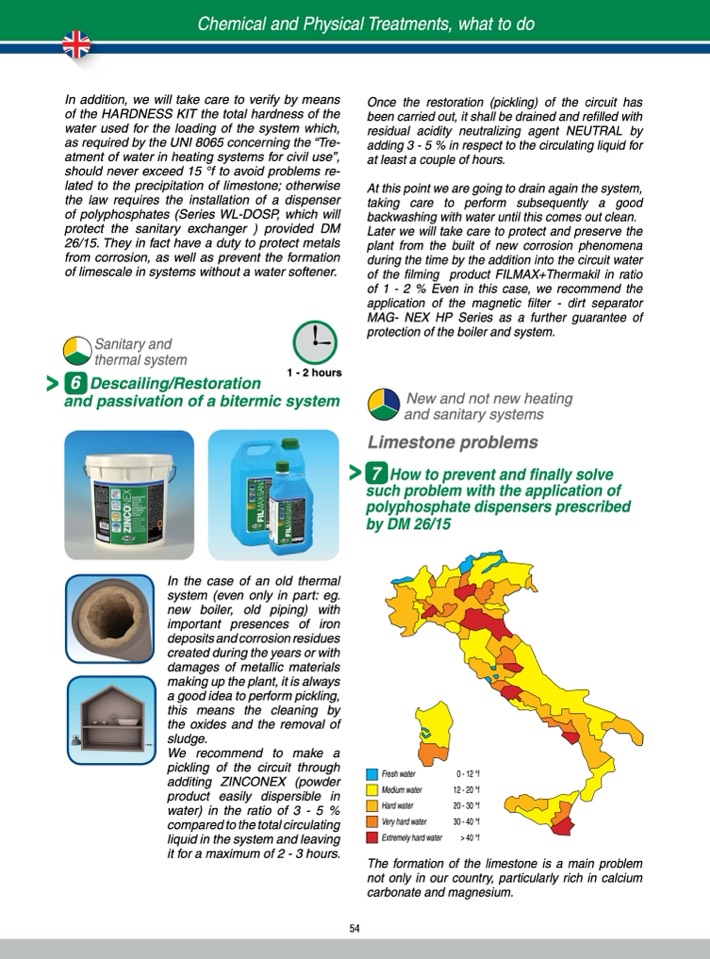
The formation of the limestone is a main problem
not only in our country, particularly rich in calcium
carbonate and magnesium.

