Chemical and Physical Treatments, what to do
C
Low temperature system
new or existing
Regarding the sanitary system (better described in
paragraph 5), we must take care to differentiate the
washing treatment in two main categories, that is
the scaling of the exchanger and the healing of the
entire sanitary circuit.
In the first case, on copper or steel exchangers, we
will use the descaling DISINEx in order to remo-
ve calcareous incrustations from the heat exchan-
ger, (while for exchangers in aluminum-silicon is
recommended the use of ZINCONEx-LQ), taking
care to dilute the product in the ratio of 10 - 20 %
with mains water, reducing the contact time of 1 - 2
hours, the time required to dissolve the limestone
from the metal surface of the heat exchanger; once
effervescence occurred and the color change from
yellow to pink -purple , add again a small amount of
the scale remover in order to ensure that the pro-
duct is not exhausted and that descaling is comple-
ted successfully.
Once the treatment is done, it is a good thing to
perform backwashing with the neutralizing residual
acidity NEUTRAL in ratio of 3 - 5 % of the circula-
ting liquid and letting it work for at least a couple of
hours.
In case it becomes necessary to restore the entire
sanitary circuit, we are going to perform a pickling
plant adding ZINCONEx powder in ratio of 3 - 5 %
compared to the total circulating liquid and leaving
it circulate for at least a couple of hours. As in the
previous case, it is always a good thing to perform
backwashing with the residual acidity neutralizing
agent NEUTRAL in ratio of 3 - 5 % of the circulating
liquid leaving it into the circuit for a couple of hours.
The next tip is to protect the system by make it circu-
late for at least 12 - 24 hours creating a recirculation
of the system by making FILMAx-SAN cirulate by a
ratio of 1.5 - 2 % of the total liquid. Then drain the
circuit and make a good backwashing with water.
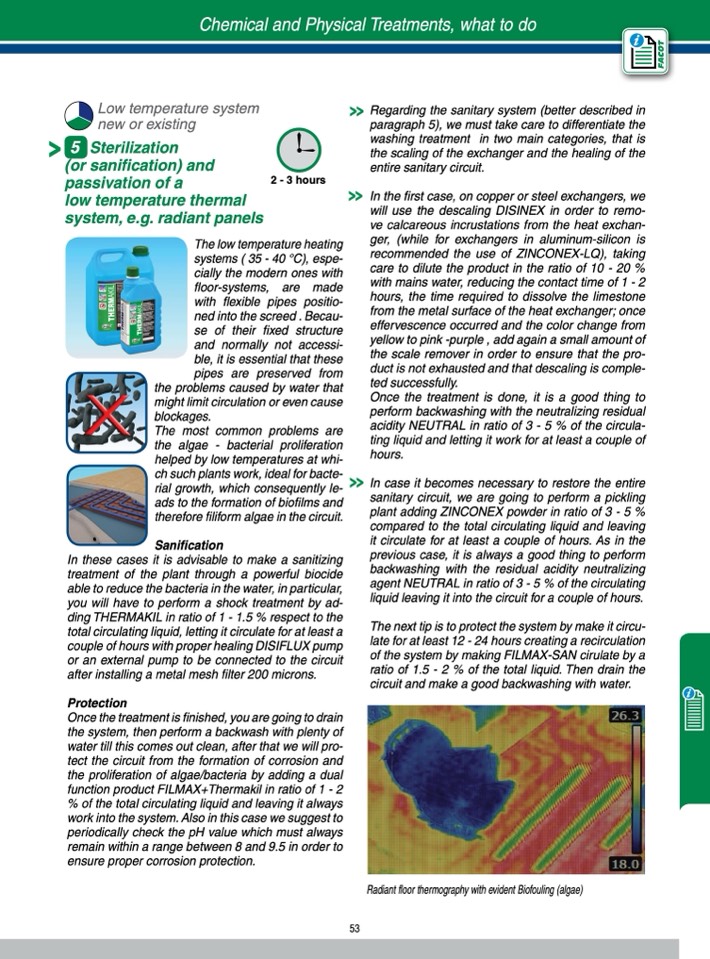
Radiant floor thermography with evident Biofouling (algae)
5 Sterilization
(or sanification) and
passivation of a
low temperature thermal
system, e.g. radiant panels
The low temperature heating
systems ( 35 - 40 °C), espe-
cially the modern ones with
floor-systems, are made
with flexible pipes positio-
ned into the screed . Becau-
se of their fixed structure
and normally not accessi-
ble, it is essential that these
pipes are preserved from
the problems caused by water that
might limit circulation or even cause
blockages.
The most common problems are
the algae - bacterial proliferation
helped by low temperatures at whi-
ch such plants work, ideal for bacte-
rial growth, which consequently le-
ads to the formation of biofilms and
therefore filiform algae in the circuit.
Sanification
In these cases it is advisable to make a sanitizing
treatment of the plant through a powerful biocide
able to reduce the bacteria in the water, in particular,
you will have to perform a shock treatment by ad-
ding THERMAKIL in ratio of 1 - 1.5 % respect to the
total circulating liquid, letting it circulate for at least a
couple of hours with proper healing DISIFLUx pump
or an external pump to be connected to the circuit
after installing a metal mesh filter 200 microns.
Protection
Once the treatment is finished, you are going to drain
the system, then perform a backwash with plenty of
water till this comes out clean, after that we will pro-
tect the circuit from the formation of corrosion and
the proliferation of algae/bacteria by adding a dual
function product FILMAx+Thermakil in ratio of 1 - 2
% of the total circulating liquid and leaving it always
work into the system. Also in this case we suggest to
periodically check the pH value which must always
remain within a range between 8 and 9.5 in order to
ensure proper corrosion protection.
2 - 3 hours
53

