Introduction
Water treatment in
RADIANT PANEL HEATING SYSTEMS
nisms is 40°C. These organisms - mainly represen-
ted by fungi in the form of a viscous sludgy mass -
are often resistant to low chlorine concentrations. It
was observed that these proliferations mainly occur
in old systems.
Interventions
When the floor heating system is obstructed, the
best solution is to remove the obstruction. To do
so, disconnect the pipe involved from the manifold
and apply a pressure generally not exceeding 3
Bars, which is the limit tolerated by non-metallic
pipes. Sometimes this limit proves insufficient to
remove the obstruction. If pressure application has
not produced any positive effects on the systems
obstructed by oxide deposits and sludge, ANTINEx
disaggregating agent for oxides, grease and sludge
shall be used. This operation will prove more effecti-
ve if the special pump DISIFLUx is used.
Prevention
Compatibility tests have shown that FACOT products
are compatible with all most commonly used types of
plastic materials for the pipe manufacturing. We the-
refore advise that you treat floor systems in the same
way as “traditional” ones. The operation consists in
thoroughly washing the system at a high water recir-
culation flow rate; protect the system against corro-
sion (oxide deposits) treating it with FILMAx or, where
protection against frost is required, with FILMAx &
ANTIFREEZE. Moreover, if FILMAx is not present, a
suitable dose of THERMAKIL
®
should be added in the
system to prevent microbiological growth.
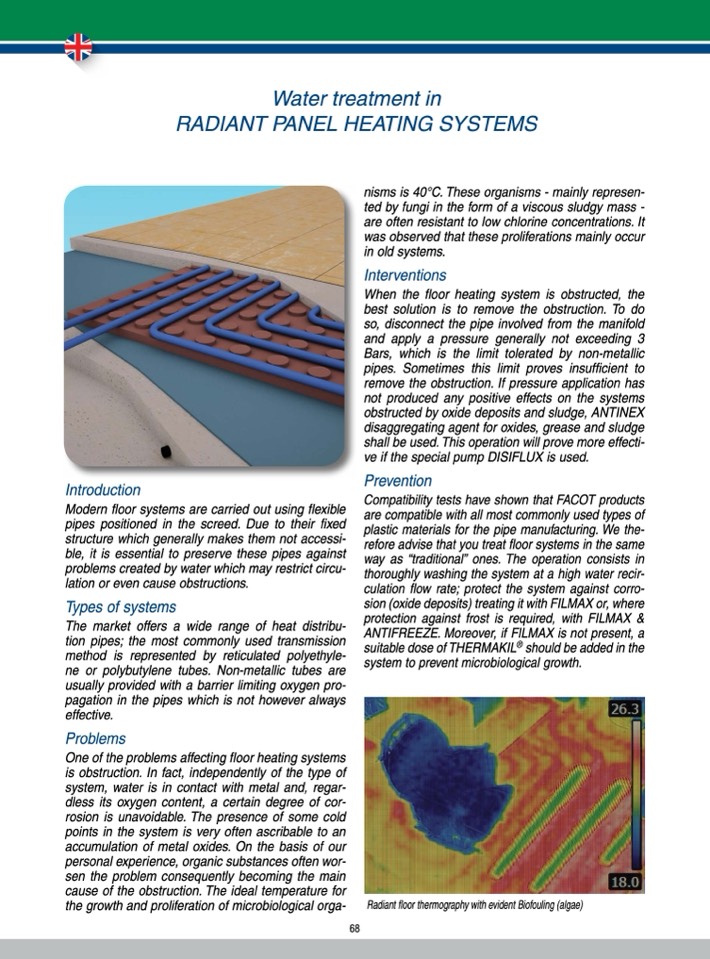
Radiant floor thermography with evident Biofouling (algae)
Modern floor systems are carried out using flexible
pipes positioned in the screed. Due to their fixed
structure which generally makes them not accessi-
ble, it is essential to preserve these pipes against
problems created by water which may restrict circu-
lation or even cause obstructions.
Types of systems
The market offers a wide range of heat distribu-
tion pipes; the most commonly used transmission
method is represented by reticulated polyethyle-
ne or polybutylene tubes. Non-metallic tubes are
usually provided with a barrier limiting oxygen pro-
pagation in the pipes which is not however always
effective.
Problems
One of the problems affecting floor heating systems
is obstruction. In fact, independently of the type of
system, water is in contact with metal and, regar-
dless its oxygen content, a certain degree of cor-
rosion is unavoidable. The presence of some cold
points in the system is very often ascribable to an
accumulation of metal oxides. On the basis of our
personal experience, organic substances often wor-
sen the problem consequently becoming the main
cause of the obstruction. The ideal temperature for
the growth and proliferation of microbiological orga-
68

