LEGIONELLA in systems, how to prevent it and fight it
Legionella is a microorganism commonly found in na-
ture, where it is mainly associated with the presence of
water, whether it be rivers, lakes, reservoirs, thermal
springs or human use when it flows out of our taps. To-
day, infections caused by Legionella are a serious and
worrying problem due to the ever-increasing presence
of bacteria in hot water at homes, hotels, campsites,
swimming pools, hospitals, nursing homes, and in any
situation where the water temperature is at least 25 °C.
One thing that clearly does not help is the return circuit
of central heating systems and the large amounts of
hot water stored, due in some cases to solar power
systems, thus putting into question the safety of sha-
red systems in apartment blocks or other similar resi-
dential buildings, where the Legionella risk is growing
and growing. But that is not all... Particularly high and
dangerous concentrations can also be found in air con-
ditioning systems made up of cooling towers, evapo-
rative condensers or air humidifiers. We are often fa-
ced with this problem in existing systems where there
are already many issues such as corrosion, limescale,
dead circuit branches in which there is no continuous
water circulation, and accumulations not regularly mo-
nitored, all of which are aspects that favour the growth
of Legionella itself.
A “dangerous” bacterium
The bacteria actually enter our body through the
airways by the inhalation or aspiration of aerosols.
The smaller the drops of water, the more the germ can
easily reach the lower respiratory tract, especially the
lungs. There are various sources of aerosols: turning
on tap or a shower fed by a contaminated water sy-
stem, whirlpool bathtubs and swimming pools; Turkish
baths and saunas; ornamental fountains especially if
located indoors; garden irrigation systems, waste wa-
ter systems, cooling towers and evaporative conden-
sers, and air conditioning systems in general. The lat-
ter, in places where they have been installed, create a
real Legionella risk if they do not receive adequate and
regular maintenance.
The importance of maintenance
It is necessary to provide adequate prevention mea-
sures for regular monitoring and suitable maintenance
of air conditioners.It is also essential to ensure regular
cleaning and sanitising of equipment and the instal-
lation of filters, at the beginning and at the end of the
air duct, in order to preserve the internal components
of the system. For this, Facot recommends the use of
the CLIMANET and CLIMASAN sanitisers, ideal for
killing and eliminating Legionella bacteria, also in ac-
cordance with the provisions of Law 155 on HACCP.
CLIMANET Spray with a foam-detergent action can be
used for the treatment of finned radiators of air condi-
tioners and fan-coils, finned packs, internal and exter-
nal parts; CLIMASAN Spray, on the other hand, can
be used as a sanitising-deodorising product (pleasant
scented), with an antibacterial-germicidal action, spe-
cially designed for air conditioner filters, car filters, etc.
Alternatively, we can use CLIMANET in a concentrated
liquid version, with a detergent-degreasing action, to
be diluted with water to 1 - 5 % and sprayed directly
onto the surface to be sanitised using special foaming
nozzles; or CLIMANET FILTRI, specifically designed
to clean and sanitise industrial filters of hot air genera-
tors, air conditioning systems, but also extractor hoods
for bars, community centres, restaurants, as well as for
the removal of fatty substances in general from PVC
tarpaulins, covers, vehicles, etc.
Prevention in water systems
In water systems, it is always good practice, besides
proper and careful maintenance, to perform adequate
disinfection treatments in order to ensure you achieve
the quality parameters in line with current needs, in
compliance with legal requirements, in particular Le-
gislative Decree n° 31 of 2 February 2001. Given their
size, bacteria can actually penetrate very easilyin our
hydraulic systems, often assisted by tiny insects that
are very mobile and able to enter. Once in the system,
they tend to settle on all surfaces of tanks and pipes,
regardless of the materials with which they are made,
although some studies show that the Biofilm (ecologi-
cal niche that represents for opportunistic pathogenic
bacteria, an excellent source shelter and nourishment)
develops faster inside plastic pipes than metal ones,
since microorganisms use the nutrients present in the
organic content of the material that constitutes the pipe
itself.
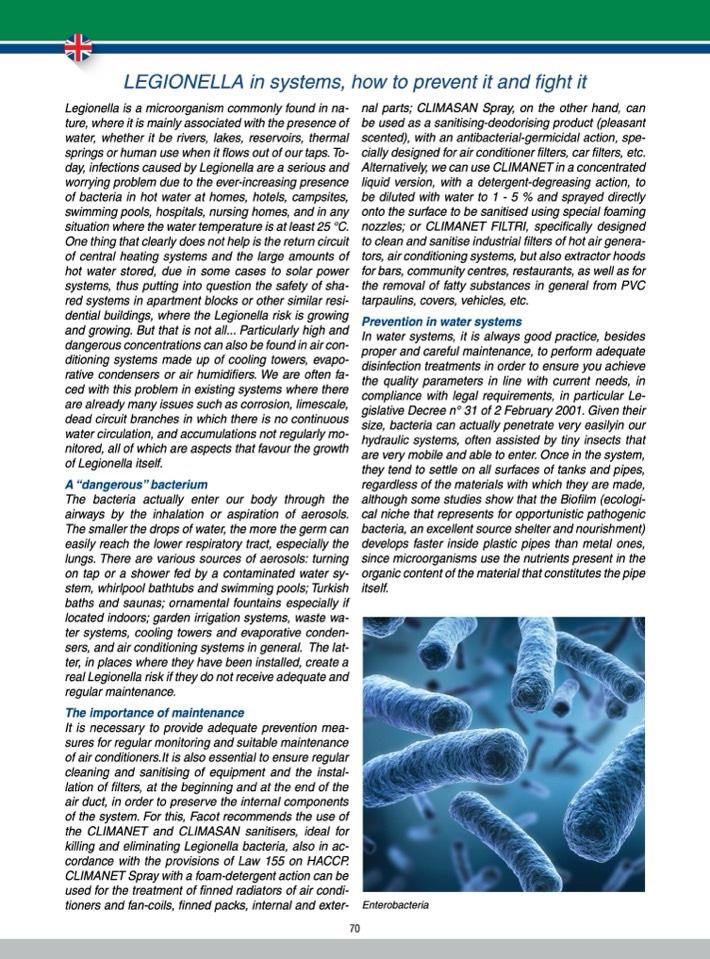
Enterobacteria
70

