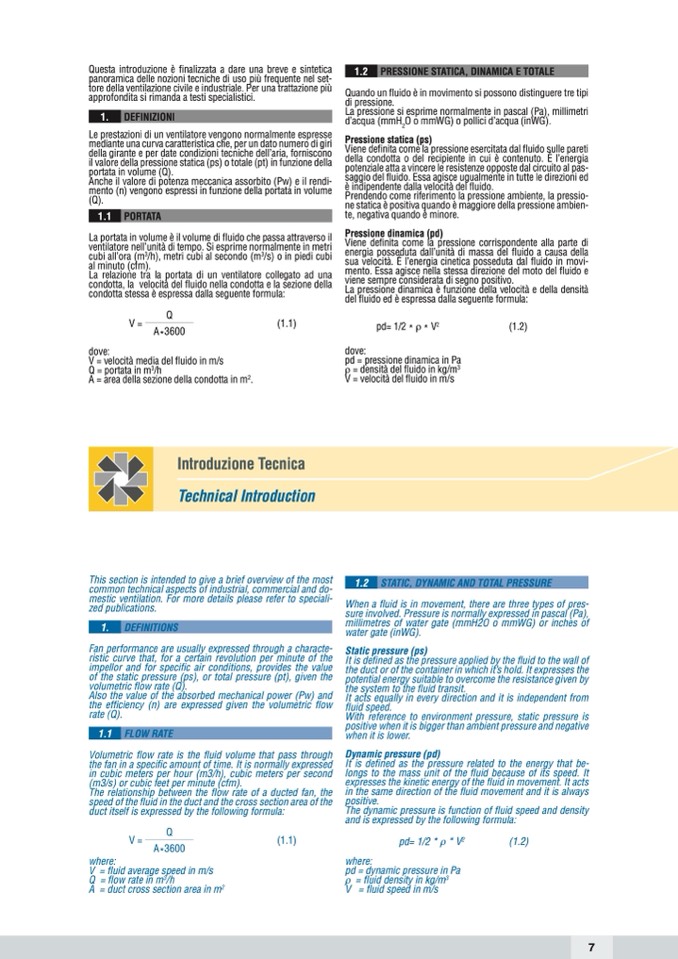
Questa introduzione è finalizzata a dare una breve e sintetica
panoramica delle nozioni tecniche di uso più frequente nel set-
tore della ventilazione civile e industriale. Per una trattazione più
approfondita si rimanda a testi specialistici.
Quando un fluido è in movimento si possono distinguere tre tipi
di pressione.
La pressione si esprime normalmente in pascal (Pa), millimetri
d’acqua (mmH
2
O o mmWG) o pollici d’acqua (inWG).
Viene definita come la pressione esercitata dal fluido sulle pareti
della condotta o del recipiente in cui è contenuto. É l’energia
potenziale atta a vincere le resistenze opposte dal circuito al pas-
saggio del fluido. Essa agisce ugualmente in tutte le direzioni ed
è indipendente dalla velocità del fluido.
1.2
PRESSIONE STATICA, DINAMICA E TOTALE
1.
DEFINIZIONI
Le prestazioni di un ventilatore vengono normalmente espresse
mediante una curva caratteristica che, per un dato numero di giri
della girante e per date condizioni tecniche dell’aria, forniscono
il valore della pressione statica (ps) o totale (pt) in funzione della
portata in volume (Q).
Pressione statica (ps)
Anche il valore di potenza meccanica assorbito (Pw) e il rendi-
mento (n) vengono espressi in funzione della portata in volume
(Q).
Prendendo come riferimento la pressione ambiente, la pressio-
ne statica è positiva quando è maggiore della pressione ambien-
te, negativa quando è minore.
1.1
PORTATA
La portata in volume è il volume di fluido che passa attraverso il
ventilatore nell’unità di tempo. Si esprime normalmente in metri
cubi all’ora (m
3
/h), metri cubi al secondo (m
3
/s) o in piedi cubi
al minuto (cfm).
Pressione dinamica (pd)
La relazione tra la portata di un ventilatore collegato ad una
condotta, la velocità del fluido nella condotta e la sezione della
condotta stessa è espressa dalla seguente formula:
Viene definita come la pressione corrispondente alla parte di
energia posseduta dall’unità di massa del fluido a causa della
sua velocità. É l’energia cinetica posseduta dal fluido in movi-
mento. Essa agisce nella stessa direzione del moto del fluido e
viene sempre considerata di segno positivo.
pd=1/2*r*V
2
(1.2)
dove:
pd = pressione dinamica in Pa
r = densità del fluido in kg/m
3
V = velocità del fluido in m/s
V =
Q
A*3600
dove:
V = velocità media del fluido in m/s
Q = portata in m
3
/h
A = area della sezione della condotta in m
2
.
(1.1)
La pressione dinamica è funzione della velocità e della densità
del fluido ed è espressa dalla seguente formula:
This section is intended to give a brief overview of the most
common technical aspects of industrial, commercial and do-
mestic ventilation. For more details please refer to speciali-
zed publications.
When a fluid is in movement, there are three types of pres-
sure involved. Pressure is normally expressed in pascal (Pa),
millimetres of water gate (mmH2O o mmWG) or inches of
water gate (inWG).
It is defined as the pressure applied by the fluid to the wall of
the duct or of the container in which it’s hold. It expresses the
potential energy suitable to overcome the resistance given by
the system to the fluid transit.
1.2
STATIC, DYNAMIC AND TOTAL PRESSURE
1.
DEFINITIONS
Fan performance are usually expressed through a characte-
ristic curve that, for a certain revolution per minute of the
impellor and for specific air conditions, provides the value
of the static pressure (ps), or total pressure (pt), given the
volumetric flow rate (Q).
Static pressure (ps)
Also the value of the absorbed mechanical power (Pw) and
the efficiency (n) are expressed given the volumetric flow
rate (Q).
It acts equally in every direction and it is independent from
fluid speed.
With reference to environment pressure, static pressure is
positive when it is bigger than ambient pressure and negative
when it is lower.
1.1
FLOW RATE
Volumetric flow rate is the fluid volume that pass through
the fan in a specific amount of time. It is normally expressed
in cubic meters per hour (m3/h), cubic meters per second
(m3/s) or cubic feet per minute (cfm).
Dynamic pressure (pd)
The relationship between the flow rate of a ducted fan, the
speed of the fluid in the duct and the cross section area of the
duct itself is expressed by the following formula:
It is defined as the pressure related to the energy that be-
longs to the mass unit of the fluid because of its speed. It
expresses the kinetic energy of the fluid in movement. It acts
in the same direction of the fluid movement and it is always
positive.
V =
Q
A*3600
where:
V = fluid average speed in m/s
Q = flow rate in m
3
/h
A = duct cross section area in m
2
The dynamic pressure is function of fluid speed and density
and is expressed by the following formula:
(1.1)
pd= 1/2 * r * V
2
where:
pd = dynamic pressure in Pa
r = fluid density in kg/m
3
V = fluid speed in m/s
(1.2)
Introduzione Tecnica
Technical Introduction
7

