Introduzione Tecnica
Condizioni che possono determinare un’esplosione:
• presenzadisostanzeinfiammabilidisperseinariasottoforma
di gas, vapore o nebbia o polvere;
• la temperatura di infiammabilità della sostanza
è uguale o in-
feriore alla temperatura a cui può venirsi a trovare per cause
dipendenti da temperatura ambiente, temperatura di lavora-
zione, o per altri motivi (es. contatto con superfici calde);
• la concentrazione di gas, vapore o nebbia o polvere emessa
nell’intorno del punto d’innesco è compresa nell’intervallo di
infiammabilità;
• è presente entro il volume occupato dai gas, vapori, nebbie o
polveri in concentrazione pericolosa una sorgente di accensio-
ne di energia sufficiente ad innescare l’atmosfera esplosiva;
• combustibile e comburente sono presenti in quantità suffi-
ciente a sostenere l’esplosione che si manifesta con un au-
mento di volume in grado di provocare un’onda d’urto dagli
effetti distruttivi.
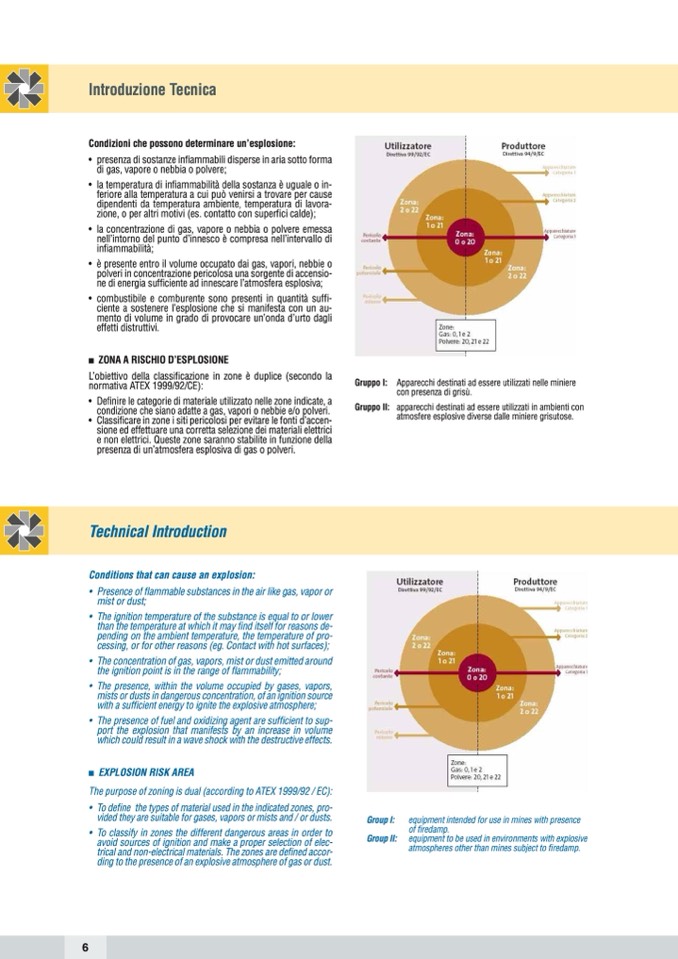
ZONA A RISCHIO D’ESPLOSIONE
L’obiettivo della classificazione in zone è duplice (secondo la
normativa ATEX 1999/92/CE):
Gruppo I:
Gruppo II:
Apparecchi destinati ad essere utilizzati nelle miniere
con presenza di grisù.
apparecchi destinati ad essere utilizzati in ambienti con
atmosfere esplosive diverse dalle miniere grisutose.
• Definirelecategoriedimaterialeutilizzatonellezoneindicate,a
condizione che siano adatte a gas, vapori o nebbie e/o polveri.
• Classificareinzoneisitipericolosiperevitarelefontid’accen-
sione ed effettuare una corretta selezione dei materiali elettrici
e non elettrici. Queste zone saranno stabilite in funzione della
presenza di un’atmosfera esplosiva di gas o polveri.
Technical Introduction
Conditions that can cause an explosion:
• Presenceofflammablesubstancesintheairlikegas,vaporor
mist or dust;
• The ignition temperature of the substance is equal to or lower
than the temperature at which it may find itself for reasons de-
pending on the ambient temperature, the temperature of pro-
cessing, or for other reasons (eg. Contact with hot surfaces);
• Theconcentrationofgas,vapors,mistordustemittedaround
the ignition point is in the range of flammability;
• The presence, within the volume occupied by gases, vapors,
mists or dusts in dangerous concentration, of an ignition source
with a sufficient energy to ignite the explosive atmosphere;
• The presence of fuel and oxidizing agent are suf
ficient to sup-
port the explosion that manifests by an increase in volume
which could result in a wave shock with the destructive effects.
EXPLOSION RISK AREA
The purpose of zoning is dual (according to ATEX 1999/92 / EC):
• To define the types of material used in the indicated zones, pro-
vided they are suitable for gases, vapors or mists and / or dusts.
• To classify in zones the different dangerous areas in order to
avoid sources of ignition and make a proper selection of elec-
trical and non-electrical materials. The zones are defined accor-
ding to the presence of an explosive atmosphere of gas or dust.
Group I:
Group II:
equipment intended for use in mines with presence
of firedamp.
equipment to be used in environments with explosive
atmospheres other than mines subject to firedamp.
6

