Microscopic spore image
them may give rise to problems through infections,
production of toxins or hyperstimulation of the im-
mune system. Fungal infections can range from re-
latively benign to other dangerous diseases, such
as lung histoplasmosis or infections of the species
Aspergillus in people with impaired immune system.
Fungi can produce hypersensitivity reactions invol-
ving the immune system, such as allergies, asthma
and al-three diseases. All these reactions follow the
inhalation of fungi or related antigens. Especially in
children there was an increase in these reactions,
such as asthma, in many countries.
Viruses
Viruses are extremely small microorganisms, visi-
ble only under the electron microscope, consisting
of genetic material (DNA or RNA) enclosed in a
protein envelope (capsid) and, often, even in an
outer membrane made of phospholipides (a type of
fats) and proteins, called pericapside.
Viruses and health risks
Viruses are not able to reproduce (replicate) in-
dependently, but exclusively within the cells of the
tissues of the organism, causing their destruction
or, for some particular viruses, transformation into
cancer cells.
The resistance of viruses in the environment is ex-
tremely low, although some viruses (for example,
some respiratory viruses) can survive for a long
time. Viruses can infect people by air, food, throu-
gh sexual intercourse or through vectors (especial-
ly insects); they can cause local symptoms borne
by different systems (e.g. respiratory, digestive or
uro-genital system) or general (systemic) if it spre-
ads throughout the body. Some types of viruses
can be fought with effective drugs or prevented due
to specific vaccination.
Focus on Covid-19
Coronaviruses (CoV) are a wide family of respira-
tory viruses that can cause mild to moderate dise-
ases, from the common cold to respiratory syndro-
mes such as MERS (Middle Eastern Respiratory
Syndrome, Middle East respiratory syndrome) and
SARS (severe acute respiratory syndrome, Seve-
re acute respiratory syndrome) They are called so
due to the crown shaped tips that are present on
their surface. A new coronavirus is a new strain of
coronavirus that has never been previously identi-
fied in humans. The human coronaviruses known to
date, common around the world, are seven, some
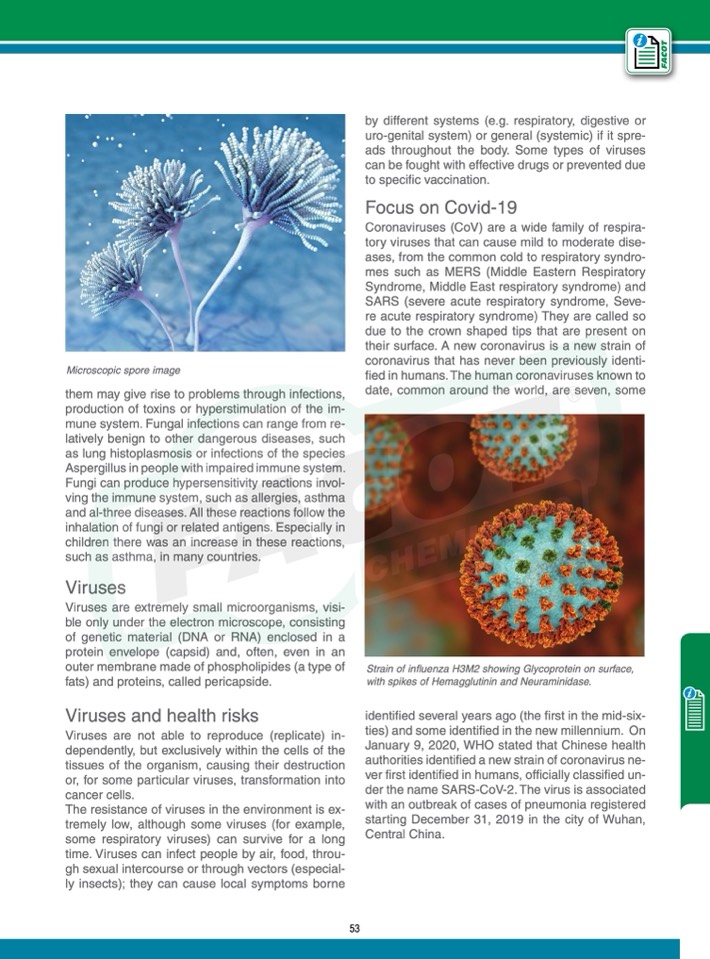
Strain of influenza H3M2 showing Glycoprotein on surface,
with spikes of Hemagglutinin and Neuraminidase.
identified several years ago (the first in the mid-six-
ties) and some identified in the new millennium. On
January 9, 2020, WHO stated that Chinese health
authorities identified a new strain of coronavirus ne-
ver first identified in humans, officially classified un-
der the name SARS-CoV-2. The virus is associated
with an outbreak of cases of pneumonia registered
starting December 31, 2019 in the city of Wuhan,
Central China.
53

