Air systems treatment guidelines
PATHOGENS IN DETAIL
Mold and fungus
Mold and fungi are mono or multi-cellular organi-
sms that are found almost everywhere: in the soil,
on plants, on animals, in the air and last but not le-
ast, in living and working environments. In buildings
under normal hygienic conditions, where there is no
active growth of fungi, you can count from 3,000 to
10,000 spores per cubic meter in air, with a diame-
ter ranging from 1 to 60 microns. The most common
species recognized in the interior are Cladospo-
rium, Penicillium and Aspergillus, but many others
can also be found. When certain conditions arise,
mold produces a large amount of mycotoxynes whi-
ch, when inhaled, can cause health problems. Moi-
sture is a necessary condition for the germination
of spores and for the continuous growth of fungi.
Many buildings, for various reasons, suffer from
excess moisture and conditions that promote the
proliferation of these agents: in this case, further
spores are produced that are dragged by air move-
ment in the room and tend to colonize other areas.
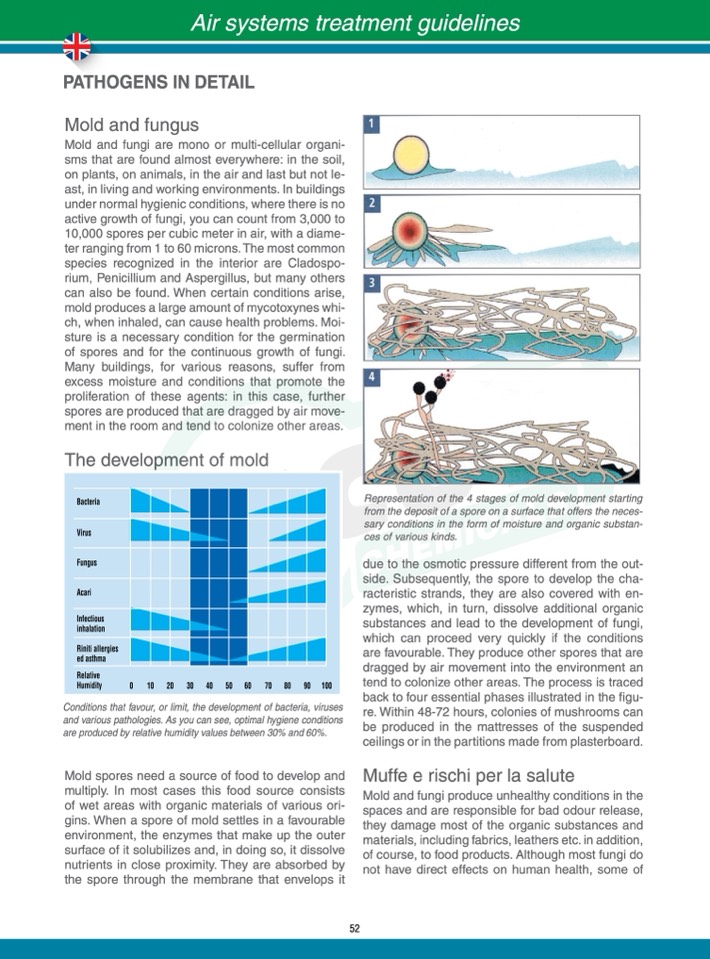
The development of mold
Conditions that favour, or limit, the development of bacteria, viruses
and various pathologies. As you can see, optimal hygiene conditions
are produced by relative humidity values between 30% and 60%.
Mold spores need a source of food to develop and
multiply. In most cases this food source consists
of wet areas with organic materials of various ori-
gins. When a spore of mold settles in a favourable
environment, the enzymes that make up the outer
surface of it solubilizes and, in doing so, it dissolve
nutrients in close proximity. They are absorbed by
the spore through the membrane that envelops it
Representation of the 4 stages of mold development starting
from the deposit of a spore on a surface that offers the neces-
sary conditions in the form of moisture and organic substan-
ces of various kinds.
due to the osmotic pressure different from the out-
side. Subsequently, the spore to develop the cha-
racteristic strands, they are also covered with en-
zymes, which, in turn, dissolve additional organic
substances and lead to the development of fungi,
which can proceed very quickly if the conditions
are favourable. They produce other spores that are
dragged by air movement into the environment an
tend to colonize other areas. The process is traced
back to four essential phases illustrated in the figu-
re. Within 48-72 hours, colonies of mushrooms can
be produced in the mattresses of the suspended
ceilings or in the partitions made from plasterboard.
Muffe e rischi per la salute
Mold and fungi produce unhealthy conditions in the
spaces and are responsible for bad odour release,
they damage most of the organic substances and
materials, including fabrics, leathers etc. in addition,
of course, to food products. Although most fungi do
not have direct effects on human health, some of
52

