Collegamento tra componenti del sistema a doppio o-ring Eurotis
Connection between Eurotis double o-ring system components
Collegamento tra componenti del si-
stema a doppio o-ring Eurotis e altri
sistemi / materiali
Per collegare un tubo CSST ad altri sistemi o materiali si de-
vono utilizzare sempre ed unicamente gli appositi raccordi
di unione. Per garantire la tenuta in pressione sulla
filettatura
si devono sempre utilizzare, sia per
filettature di tipo paral-
lelo (cilindrico) che conico, prodotti a tenuta conformi alle
norme della serie EN 751 (ad esempio: sigillanti, canapa,
fi-
bre sintetiche, nastri di teflon, etc.) accertandosi della loro
compatibilità con il
fluido trasportato.
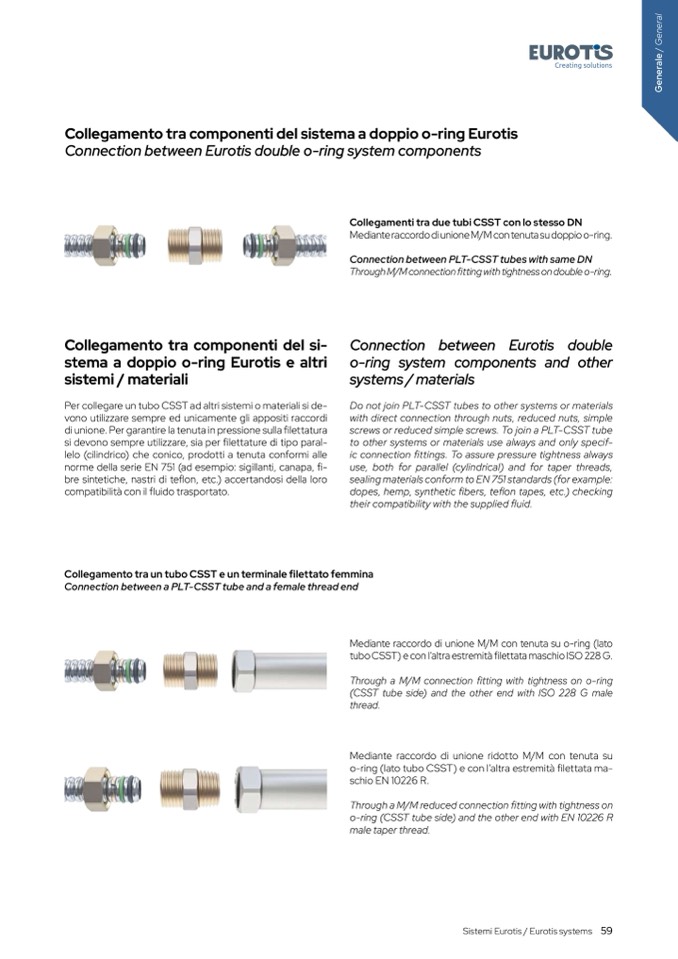
Collegamenti tra due tubi CSST con lo stesso DN
Mediante raccordo di unione M/M con tenuta su doppio o-ring.
Connection between PLT-CSST tubes with same DN
Through M/M connection
fitting with tightness on double o-ring.
Connection between Eurotis double
o-ring system components and other
systems / materials
Do not join PLT-CSST tubes to other systems or materials
with direct connection through nuts, reduced nuts, simple
screws or reduced simple screws. To join a PLT-CSST tube
to other systems or materials use always and only specif-
ic connection
fittings. To assure pressure tightness always
use, both for parallel (cylindrical) and for taper threads,
sealing materials conform to EN 751 standards (for example:
dopes, hemp, synthetic fibers, teflon tapes, etc.) checking
their compatibility with the supplied
fluid.
Collegamento tra un tubo CSST e un terminale filettato femmina
Connection between a PLT-CSST tube and a female thread end
Mediante raccordo di unione M/M con tenuta su o-ring (lato
tubo CSST) e con l’altra estremit
à
filettata maschio ISO 228 G.
Through a M/M connection
fitting with tightness on o-ring
(CSST tube side) and the other end with ISO 228 G male
thread.
Mediante raccordo di unione ridotto M/M con tenuta su
o-ring (lato tubo CSST) e con l’altra estremità filettata ma-
schio EN 10226 R.
Through a M/M reduced connection fitting with tightness on
o-ring (CSST tube side) and the other end with EN 10226 R
male taper thread.
Sistemi Eurotis / Eurotis systems 59
G
e
n
e
r
a
l
e
/
G
e
n
e
r
a
l

