INSTRUCTIONS FOR CORRECT UNDERGROUND
PLACEMENT OF ALL PLASTO UNDERGROUND TANKS
5. BURIAL IN SURFACE WATER AREAS
The presence of surface water represents a critical situation; we recommend that you consult a
specialized professional for a geomorphological report on the land. According to this the intensity
of the thrust of the ground will be defined, and the backfill and the slab will be re-dimensioned. If,
during the excavation, the aquifer is higher than the bottom of the tank, it is necessary to provide
a suitable insulation.
The resistance to ground forces can be increased by inserting electro welded meshes. Produce
the concrete slab on the bottom of the excavation site and spread a bed of washed gravel 2/6
of 10 cm to fill the corrugations on the base of the tank. Filling and backfilling should take place
gradually, so it is best to half fill the tank, backfilling simultaneously with concrete and leave it to
set for 24/36 hours. Then finish the filling and backfilling.
6. BURIAL NEAR A SLOPE
When burying is done in the vicinity of an altitude or slope, you should consult a specialized
professional for a geomorphological report on the land. According to this, the reinforced concrete
wall will be sized, which will confine the tank to balance the pressure of the soil and protect the
surrounding area from any losses.
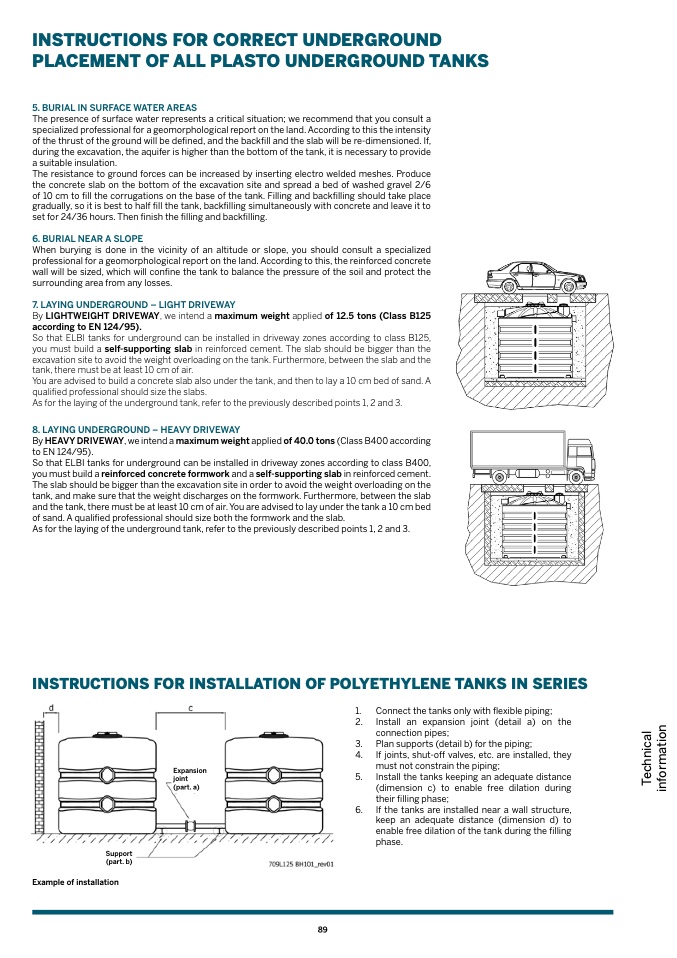
7. LAYING UNDERGROUND – LIGHT DRIVEWAY
By LIGHTWEIGHT DRIVEWAY, we intend a maximum weight applied of 12.5 tons (Class B125
according to EN 124/95).
So that ELBI tanks for underground can be installed in driveway zones according to class B125,
you must build a self-supporting slab in reinforced cement. The slab should be bigger than the
excavation site to avoid the weight overloading on the tank. Furthermore, between the slab and the
tank, there must be at least 10 cm of air.
You are advised to build a concrete slab also under the tank, and then to lay a 10 cm bed of sand. A
qualified professional should size the slabs.
As for the laying of the underground tank, refer to the previously described points 1, 2 and 3.
8. LAYING UNDERGROUND – HEAVY DRIVEWAY
By HEAVY DRIVEWAY, we intend a maximum weight applied of 40.0 tons (Class B400 according
to EN 124/95).
So that ELBI tanks for underground can be installed in driveway zones according to class B400,
you must build a reinforced concrete formwork and a self-supporting slab in reinforced cement.
The slab should be bigger than the excavation site in order to avoid the weight overloading on the
tank, and make sure that the weight discharges on the formwork. Furthermore, between the slab
and the tank, there must be at least 10 cm of air. You are advised to lay under the tank a 10 cm bed
of sand. A qualified professional should size both the formwork and the slab.
As for the laying of the underground tank, refer to the previously described points 1, 2 and 3.
INSTRUCTIONS FOR INSTALLATION OF POLYETHYLENE TANKS IN SERIES
1.
Connect the tanks only with flexible piping;
2. Install an expansion joint (detail a) on the
connection pipes;
3. Plan supports (detail b) for the piping;
4. If joints, shut-off valves, etc. are installed, they
must not constrain the piping;
5. Install the tanks keeping an adequate distance
(dimension c) to enable free dilation during
their filling phase;
6. If the tanks are installed near a wall structure,
keep an adequate distance (dimension d) to
enable free dilation of the tank during the filling
phase.
Example of installation
Expansion
joint
(part. a)
Support
(part. b)
89
T
e
c
h
n
i
c
a
l
i
n
f
o
r
m
a
t
i
o
n

