Instructions for Laying
FSR 8.70.02
FLEXWELL Safety Pipe
Instructions for laying and mounting FLEXWELL Safety piping
FSR DN 12 – DN 150
Make sure that the ends of the pipes have been sealed so
that no foreign bodies can find their way into them.
Store the piping at a temporary interim storage position
before proceeding to laying.
3 Determining the lengths and laying the piping
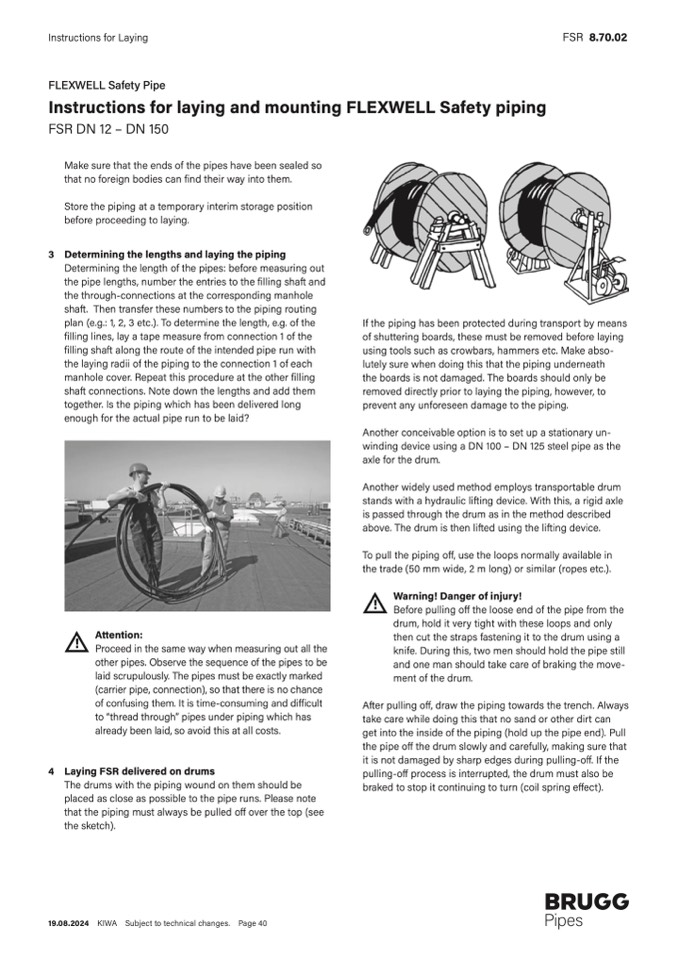
Determining the length of the pipes: before measuring out
the pipe lengths, number the entries to the filling shaft and
the through-connections at the corresponding manhole
shaft. Then transfer these numbers to the piping routing
plan (e.g.: 1, 2, 3 etc.). To determine the length, e.g. of the
filling lines, lay a tape measure from connection 1 of the
filling shaft along the route of the intended pipe run with
the laying radii of the piping to the connection 1 of each
manhole cover. Repeat this procedure at the other filling
shaft connections. Note down the lengths and add them
together. Is the piping which has been delivered long
enough for the actual pipe run to be laid?
If the piping has been protected during transport by means
of shuttering boards, these must be removed before laying
using tools such as crowbars, hammers etc. Make abso-
lutely sure when doing this that the piping underneath
the boards is not damaged. The boards should only be
removed directly prior to laying the piping, however, to
prevent any unforeseen damage to the piping.
Another conceivable option is to set up a stationary un-
winding device using a DN 100 – DN 125 steel pipe as the
axle for the drum.
Another widely used method employs transportable drum
stands with a hydraulic lifting device. With this, a rigid axle
is passed through the drum as in the method described
above. The drum is then lifted using the lifting device.
To pull the piping off, use the loops normally available in
the trade (50 mm wide, 2 m long) or similar (ropes etc.).
Warning! Danger of injury!
Before pulling off the loose end of the pipe from the
drum, hold it very tight with these loops and only
then cut the straps fastening it to the drum using a
knife. During this, two men should hold the pipe still
and one man should take care of braking the move-
ment of the drum.
After pulling off, draw the piping towards the trench. Always
take care while doing this that no sand or other dirt can
get into the inside of the piping (hold up the pipe end). Pull
the pipe off the drum slowly and carefully, making sure that
it is not damaged by sharp edges during pulling-off. If the
pulling-off process is interrupted, the drum must also be
braked to stop it continuing to turn (coil spring effect).
Attention:
!
4 Laying FSR delivered on drums
The drums with the piping wound on them should be
placed as close as possible to the pipe runs. Please note
that the piping must always be pulled off over the top (see
the sketch).
Proceed in the same way when measuring out all the
other pipes. Observe the sequence of the pipes to be
laid scrupulously. The pipes must be exactly marked
(carrier pipe, connection), so that there is no chance
of confusing them. It is time-consuming and difficult
to “thread through” pipes under piping which has
already been laid, so avoid this at all costs.
19.08.2024 KIWA Subject to technical changes. Page 40
!

