Instructions for Laying
FSR 8.70.03
FLEXWELL Safety Pipe
Instructions for laying and mounting FLEXWELL Safety piping
FSR DN 12 – DN 150
!
Warning! Danger of injury!
The piping has an angular momentum after
pulling-off which is released immediately after
it is sawn through.
The ends, which are now open and exposed, must be pro-
tected against dirt and contamination by means of placing
bags or caps over them. Using a white marker or other
similar means of designation (carrier pipe, connection),
mark them clearly. Place the piping where it will be in-
stalled later on.
5 Laying FSR delivered in coils
Tips for the safe handling of piping coils while unloading
them off the truck: if you are using a forklift, a crane or
similar equipment to unload the coils, only use textile loops
or textile ropes for unloading, in order to avoid damaging
the outer pipes.
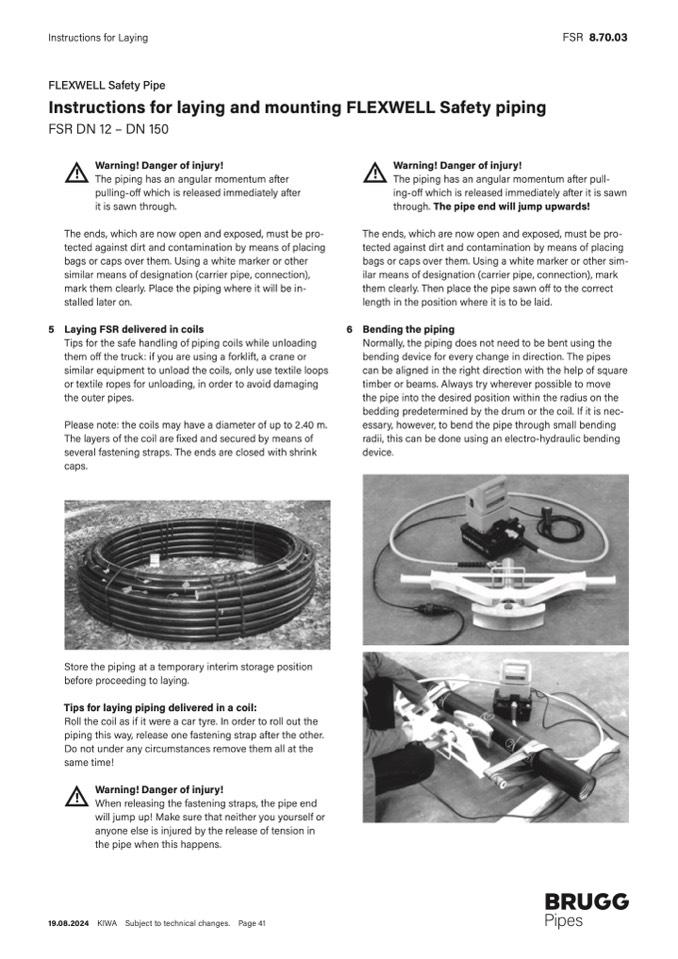
Please note: the coils may have a diameter of up to 2.40 m.
The layers of the coil are fixed and secured by means of
several fastening straps. The ends are closed with shrink
caps.
Store the piping at a temporary interim storage position
before proceeding to laying.
Tips for laying piping delivered in a coil:
Roll the coil as if it were a car tyre. In order to roll out the
piping this way, release one fastening strap after the other.
Do not under any circumstances remove them all at the
same time!
Warning! Danger of injury!
When releasing the fastening straps, the pipe end
will jump up! Make sure that neither you yourself or
anyone else is injured by the release of tension in
the pipe when this happens.
!
Warning! Danger of injury!
The piping has an angular momentum after pull-
ing-off which is released immediately after it is sawn
through. The pipe end will jump upwards!
The ends, which are now open and exposed, must be pro-
tected against dirt and contamination by means of placing
bags or caps over them. Using a white marker or other sim-
ilar means of designation (carrier pipe, connection), mark
them clearly. Then place the pipe sawn off to the correct
length in the position where it is to be laid.
6 Bending the piping
Normally, the piping does not need to be bent using the
bending device for every change in direction. The pipes
can be aligned in the right direction with the help of square
timber or beams. Always try wherever possible to move
the pipe into the desired position within the radius on the
bedding predetermined by the drum or the coil. If it is nec-
essary, however, to bend the pipe through small bending
radii, this can be done using an electro-hydraulic bending
device.
19.08.2024
KIWA Subject to technical changes. Page 41
!

