3
LEGGI DEI VENTILATORI
4.1
POTENZA E PRESSIONE SONORA
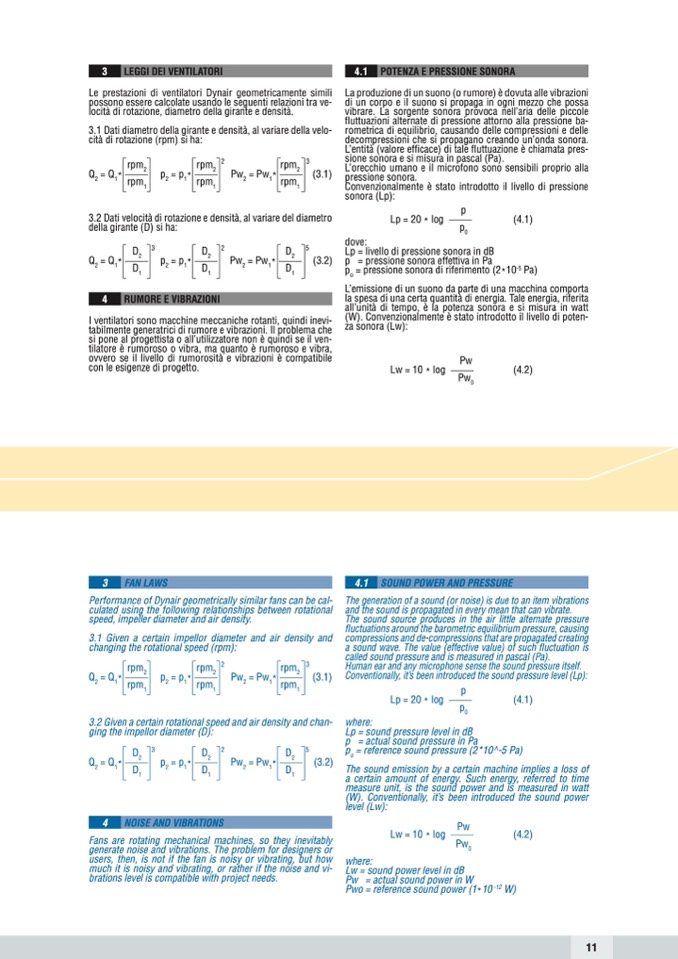
Le prestazioni di ventilatori Dynair geometricamente simili
possono essere calcolate usando le seguenti relazioni tra ve-
locità di rotazione, diametro della girante e densità.
3.1 Dati diametro della girante e densità, al variare della velo-
cità di rotazione (rpm) si ha:
La produzione di un suono (o rumore) è dovuta alle vibrazioni
di un corpo e il suono si propaga in ogni mezzo che possa
vibrare. La sorgente sonora provoca nell’aria delle piccole
fluttuazioni alternate di pressione attorno alla pressione ba-
rometrica di equilibrio, causando delle compressioni e delle
decompressioni che si propagano creando un’onda sonora.
L’entità (valore efficace) di tale fluttuazione è chiamata pres-
sione sonora e si misura in pascal (Pa).
rpm
2
p = p
2
3.2 Dati velocità di rotazione e densit
à, al variare del diametro
della girante (D) si ha:
rpm
Q = Q
2
Pw = Pw
rpm
3
2
(3.1)
L’orecchio umano e il microfono sono sensibili proprio alla
pressione sonora.
Convenzionalmente è stato introdotto il livello di pressione
sonora (Lp):
2
1
*
rpm
2
1
*
rpm
1
*
rpm
Q
2
= Q
1
*
3
2
5
D
2
D
2
D
2
D
p
2
= p
1
*
D
Pw
2
= Pw
1
*
D
1
1
1
(3.2)
Lp = 20 * log
p
(4.1)
p
0
dove:
Lp = livello di pressione sonora in dB
p = pressione sonora effettiva in Pa
p
o
= pressione sonora di riferimento (2*10
-5
Pa)
L’emissione di un suono da parte di una macchina comporta
la spesa di una certa quantità di energia. Tale energia, riferita
all’unità di tempo, è la potenza sonora e si misura in watt
(W). Convenzionalmente è stato introdotto il livello di poten-
za sonora (Lw):
2
1
1
1
4
RUMORE E VIBRAZIONI
I ventilatori sono macchine meccaniche rotanti, quindi inevi-
tabilmente generatrici di rumore e vibrazioni. Il problema che
si pone al progettista o all’utilizzatore non è quindi se il ven-
tilatore è rumoroso o vibra, ma quanto
è rumoroso e vibra,
ovvero se il livello di rumorosità e vibrazioni è compatibile
con le esigenze di progetto.
Lw = 10 * log
Pw
Pw
0
(4.2)
3
FAN LAWS
4.1
SOUND POWER AND PRESSURE
Performance of Dynair geometrically similar fans can be cal-
culated using the following relationships between rotational
speed, impeller diameter and air density.
3.1 Given a certain impellor diameter and air density and
changing the rotational speed (rpm):
The generation of a sound (or noise) is due to an item vibrations
and the sound is propagated in every mean that can vibrate.
The sound source produces in the air little alternate pressure
fluctuations around the barometric equilibrium pressure, causing
compressions and de-compressions that are propagated creating
a sound wave. The value (effective value) of such fluctuation is
called sound pressure and is measured in pascal (Pa).
Q
2
= Q
1
*
2
rpm
1
p
2
= p
1
*
(3.1)
rpm
rpm
2
2
rpm
1
rpm
3
Pw
2
= Pw
1
*
2
rpm
1
Human ear and any microphone sense the sound pressure itself.
Conventionally, it’s been introduced the sound pressure level (Lp):
Lp = 20 * log
p
(4.1)
0
where:
Lp = sound pressure level in dB
p = actual sound pressure in Pa
p
o
= reference sound pressure (2*10^-5 Pa)
(3.2)
3.2 Given a certain rotational speed and air density and chan-
ging the impellor diameter (D):
Q
2
= Q
1
*
D
3
D
2
D
5
2
p
2
= p
1
*
2
Pw
2
= Pw
1
*
2
D
1
D
1
D
1
The sound emission by a certain machine implies a loss of
a certain amount of energy. Such energy, referred to time
measure unit, is the sound power and is measured in watt
(W). Conventionally, it’s been introduced the sound power
level (Lw):
4
NOISE AND VIBRATIONS
Fans are rotating mechanical machines, so they inevitably
generate noise and vibrations. The problem for designers or
users, then, is not if the fan is noisy or vibrating, but how
much it is noisy and vibrating, or rather if the noise and vi-
brations level is compatible with project needs.
Lw = 10 * log
Pw
Pw
0
(4.2)
where:
Lw = sound power level in dB
Pw = actual sound power in W
Pwo = reference sound power (1*10
-12
W)
11

