T
e
c
h
n
i
c
a
l
I
n
f
o
INDE
X
ABC
RESISTENZA ALLO SCIVOLAMENTO
SLIP RESISTANCE | RÉSISTANCE AU GLISSEMENT | RUTSCHFESTIGKEI
T
DIN EN 16165 - Annex
B
ANSI A326.3
Classi
fication
Reference Categor
y
Interior, Dry
I
D
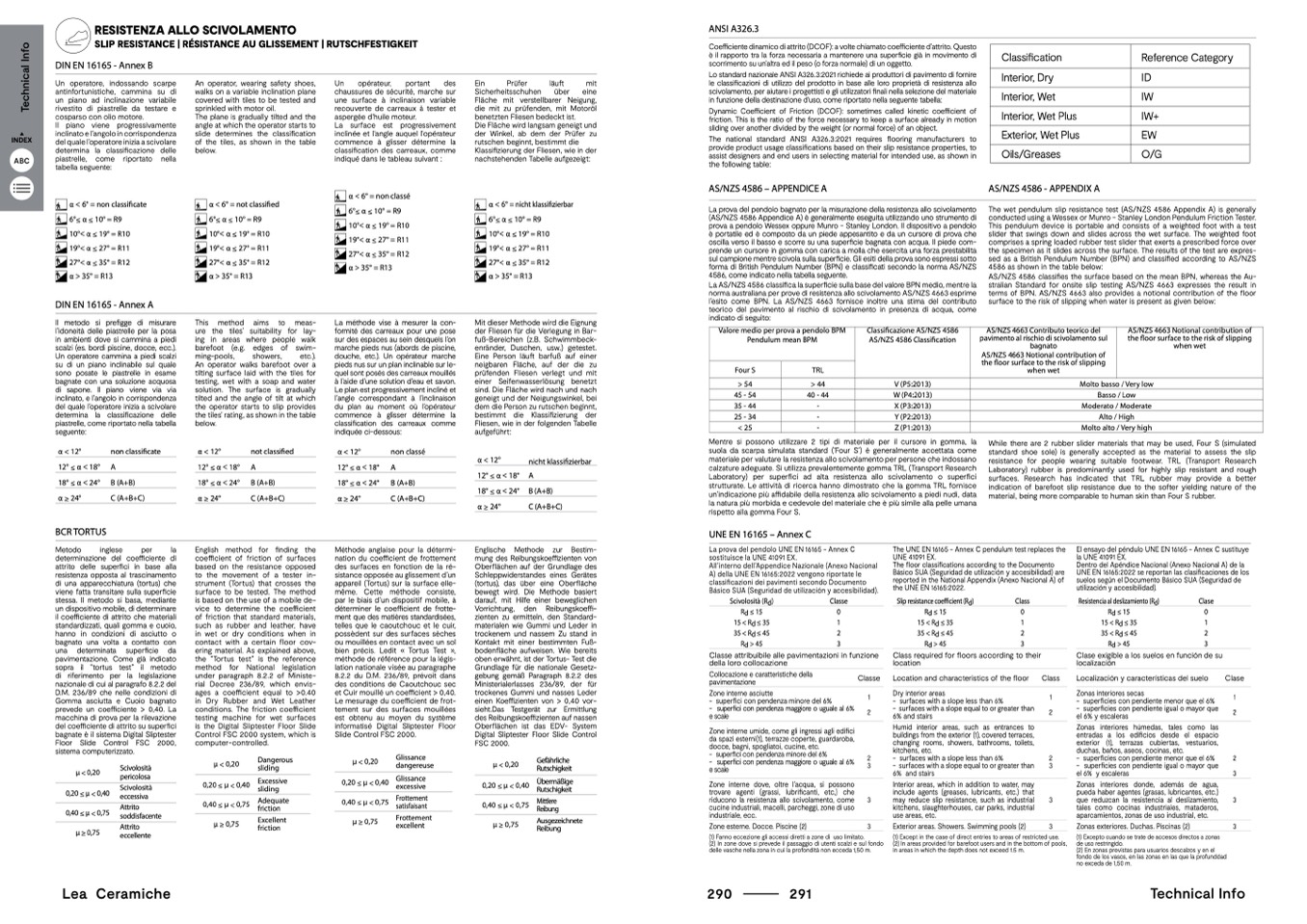
Un operatore, indossando scarp
e
antinfortunistiche, cammina su d
i
un piano ad inclinazione variabil
e
rivestito di piastrelle da testare
e
cosparso con olio motore
.
Il piano viene progressivament
e
inclinato e l’angolo in corrispondenza
del quale l’operatore inizia a scivolar
e
determina la classificazione dell
e
piastrelle, come riportato nella
tabella seguente
:
α < 6° = non classificat
e
6°≤ α ≤ 10° = R
9
10°< α ≤ 19° = R1
0
19°< α ≤ 27° = R1
1
27°< α ≤ 35° = R1
2
α > 35° = R1
3
DIN EN 16165 - Annex A
An operator, wearing safety shoes
,
walks on a variable inclination plane
covered with tiles to be tested and
sprinkled with motor oil
.
The plane is gradually tilted and th
e
angle at which the operator starts t
o
slide determines the classi
ficatio
n
of the tiles, as shown in the table
below.
α < 6° = not classified
6°≤ α ≤ 10° = R9
10°< α ≤ 19° = R10
19°< α ≤ 27° = R11
27°< α ≤ 35° = R12
α > 35° = R13
Un
opérateur,
portant
de
s
chaussures de sécurité, marche sur
une surface à inclinaison variable
recouverte de carreaux à tester et
aspergée d'huile moteur.
La surface est progressivement
inclinée et l'angle auquel l'opérateur
commence à glisser détermine l
a
classification des carreaux, comme
indiqué dans le tableau suivant
:
α < 6° = non class
é
6°≤ α ≤ 10° = R9
10°< α ≤ 19° = R1
0
19°< α ≤ 27° = R1
1
27°< α ≤ 35° = R1
2
α > 35° = R13
Ein
Prüfer
läuft
mi
t
Sicherheitsschuhen
über
ein
e
Fläche mit verstellbarer Neigung,
die mit zu prüfenden, mit Motoröl
benetzten Fliesen bedeckt ist.
Die Fläche wird langsam geneigt und
der Winkel, ab dem der Prüfer zu
rutschen beginnt, bestimmt di
e
Klassi
fizierung der Fliesen, wie in der
nachstehenden Tabelle aufgezeigt:
α < 6° = nicht klassi
fizierbar
6°≤ α ≤ 10° = R
9
10°< α ≤ 19° = R1
0
19°< α ≤ 27° = R1
1
27°< α ≤ 35° = R1
2
α > 35° = R1
3
Coefficiente dinamico di attrito (DCOF): a volte chiamato coefficiente d’attrito. Questo
è il rapporto tra la forza necessaria a mantenere una superficie già in movimento di
scorrimento su un’altra ed il peso (o forza normale) di un oggetto.
Lo standard nazionale ANSI A326.3:2021 richiede ai produttori di pavimento di fornir
e
le classificazioni di utilizzo del prodotto in base alle loro proprietà di resistenza allo
scivolamento, per aiutare i progettisti e gli utilizzatori finali nella selezione del material
e
in funzione della destinazione d'uso, come riportato nella seguente tabella:
Dynamic Coefficient of Friction (DCOF): sometimes called kinetic coefficient of
friction. This is the ratio of the force necessary to keep a surface already in motion
sliding over another divided by the weight (or normal force) of an object.
The national standard ANSI A326.3:2021 requires flooring manufacturers to
provide product usage classifications based on their slip resistance properties, to
assist designers and end users in selecting material for intended use, as shown in
the following table:
AS/NZS 4586 – APPENDICE A
Interior, Wet
I
W
Interior, Wet Plus
IW
+
Exterior, Wet Plus
EW
Oils/Greases
O/
G
AS/NZS 4586 - APPENDIX A
La prova del pendolo bagnato per la misurazione della resistenza allo scivolamento
(AS/NZS 4586 Appendice A) è generalmente eseguita utilizzando uno strumento d
i
prova a pendolo Wessex oppure Munro - Stanley London. Il dispositivo a pendol
o
è portatile ed è composto da un piede appesantito e da un cursore di prova ch
e
oscilla verso il basso e scorre su una super
ficie bagnata con acqua. Il piede com
-
prende un cursore in gomma con carica a molla che esercita una forza prestabilit
a
sul campione mentre scivola sulla super
ficie. Gli esiti della prova sono espressi sotto
forma di British Pendulum Number (BPN) e classi
ficati secondo la norma AS/NZS
4586, come indicato nella tabella seguente
.
La AS/NZS 4586 classifica la super
ficie sulla base del valore BPN medio, mentre la
norma australiana per prove di resistenza allo scivolamento AS/NZS 4663 esprim
e
l’esito come BPN. La AS/NZS 4663 fornisce inoltre una stima del contribut
o
teorico del pavimento al rischio di scivolamento in presenza di acqua, com
e
indicato di seguito:
The wet pendulum slip resistance test (AS/NZS 4586 Appendix A) is generally
conducted using a Wessex or Munro - Stanley London Pendulum Friction Tester.
This pendulum device is portable and consists of a weighted foot with a test
slider that swings down and slides across the wet surface. The weighted foo
t
comprises a spring loaded rubber test slider that exerts a prescribed force ove
r
the specimen as it slides across the surface. The results of the test are expres-
sed as a British Pendulum Number (BPN) and classified according to AS/NZ
S
4586 as shown in the table below:
AS/NZS 4586 classifies the surface based on the mean BPN, whereas the Au-
stralian Standard for onsite slip testing AS/NZS 4663 expresses the result in
terms of BPN. AS/NZS 4663 also provides a notional contribution of the floor
surface to the risk of slipping when water is present as given below
:
AS/NZS 4663 Notional contribution o
f
the floor surface to the risk of slipping
when we
t
Il metodo si prefigge di misurar
e
l’idoneità delle piastrelle per la pos
a
in ambienti dove si cammina a pied
i
scalzi (es. bordi piscine, docce, ecc.).
Un operatore cammina a piedi scalz
i
su di un piano inclinabile sul quale
sono posate le piastrelle in esame
bagnate con una soluzione acquosa
di sapone. Il piano viene via via
inclinato, e l’angolo in corrispondenza
del quale l’operatore inizia a scivolar
e
determina la classi
ficazione dell
e
piastrelle, come riportato nella tabella
seguente
:
α < 12°
non classi
ficate
This method aims to meas
-
ure the tiles’ suitability for lay-
ing in areas where people wal
k
barefoot (e.g. edges of swim-
ming-pools,
showers,
etc.)
.
An operator walks barefoot over a
tilting surface laid with the tiles for
testing, wet with a soap and water
solution. The surface is gradually
tilted and the angle of tilt at whic
h
the operator starts to slip provide
s
the tiles’ rating, as shown in the tabl
e
below.
α < 12°
not classi
fied
La méthode vise à mesurer la con
-
formité des carreaux pour une pos
e
sur des espaces au sein desquels l’on
marche pieds nus (abords de piscine
,
douche, etc.). Un opérateur march
e
pieds nus sur un plan inclinable sur le
-
quel sont posés des carreaux mouillé
s
à l’aide d’une solution d’eau et savon
.
Le plan est progressivement incliné e
t
l’angle correspondant à l’inclinaison
du plan au moment où l’opérateu
r
commence à glisser détermine l
a
classification des carreaux comm
e
indiquée ci-dessous
:
α < 12°
non class
é
12° ≤ α < 18° A
12° ≤ α < 18° A
12° ≤ α < 18° A
18° ≤ α < 24°
B (A+B)
18° ≤ α < 24°
B (A+B)
18° ≤ α < 24°
B (A+B
)
Mit dieser Methode wird die Eignun
g
der Fliesen für die Verlegung in Bar-
fuß-Bereichen (z.B. Schwimmbeck-
enränder, Duschen, usw.) getestet.
Eine Person läuft barfuß auf eine
r
neigbaren Fläche, auf der die zu
prüfenden Fliesen verlegt und mi
t
einer Seifenwasserlösung benetz
t
sind. Die Fläche wird nach und nac
h
geneigt und der Neigungswinkel, be
i
dem die Person zu rutschen beginnt
,
bestimmt die Klassifizierung der
Fliesen, wie in der folgenden Tabelle
aufgeführt:
α < 12°
nicht klassifizierbar
18° ≤ α < 24°
B (A+B)
Valore medio per prova a pendolo BP
M
Pendulum mean BPM
Four S
Classificazione AS/NZS 4586
AS/NZS 4586 Classi
ficatio
n
TR
L
AS/NZS 4663 Contributo teorico de
l
pavimento al rischio di scivolamento su
l
bagnat
o
AS/NZS 4663 Notional contribution o
f
the floor surface to the risk of slippin
g
when wet
> 54
> 44
V (P5:2013)
Molto basso / Very low
45 - 54
40 - 44
W (P4:2013)
Basso / Low
35 - 44
-
X (P3:2013)
Moderato / Moderat
e
25 - 34
-
Y (P2:2013)
Alto / High
< 25
-
Z (P1:2013)
Molto alto / Very hig
h
12° ≤ α < 18°
A
α ≥ 24°
C (A+B+C)
α ≥ 24°
C (A+B+C
)
α ≥ 24°
C (A+B+C)
While there are 2 rubber slider materials that may be used, Four S (simulate
d
standard shoe sole) is generally accepted as the material to assess the sli
p
resistance for people wearing suitable footwear. TRL (Transport Research
Laboratory) rubber is predominantly used for highly slip resistant and roug
h
surfaces. Research has indicated that TRL rubber may provide a better
indication of barefoot slip resistance due to the softer yielding nature of the
material, being more comparable to human skin than Four S rubber.
α ≥ 24°
C (A+B+C)
BCR TORTU
S
Metodo
inglese
per
la
determinazione del coe
fficiente di
attrito delle super
fici in base alla
resistenza opposta al trascinamento
di una apparecchiatura (tortus) che
viene fatta transitare sulla super
ficie
stessa. Il metodo si basa, mediant
e
un dispositivo mobile, di determinare
il coe
fficiente di attrito che materiali
standardizzati, quali gomma e cuoio
,
hanno in condizioni di asciutto o
bagnato una volta a contatto co
n
una determinata superficie da
pavimentazione. Come già indicat
o
sopra il “tortus test” il metod
o
di riferimento per la legislazion
e
nazionale di cui al paragrafo 8.2.2 de
l
D.M. 236/89 che nelle condizioni d
i
Gomma asciutta e Cuoio bagnat
o
prevede un coe
fficiente > 0,40. La
macchina di prova per la rilevazion
e
del coefficiente di attrito su super
fici
bagnate è il sistema Digital Sliptester
Floor Slide Control FSC 2000,
sistema computerizzato.
µ < 0,20
Scivolosità
pericolos
a
0,20 ≤ µ < 0,40
Scivolosit
à
eccessiv
a
0,40 ≤ µ < 0,75
Attrito
soddisfacente
English method for
finding th
e
coefficient of friction of surfaces
based on the resistance opposed
to the movement of a tester in
-
strument (Tortus) that crosses the
surface to be tested. The metho
d
is based on the use of a mobile de
-
vice to determine the coe
fficient
of friction that standard materials
,
such as rubber and leather, hav
e
in wet or dry conditions when i
n
contact with a certain floor cov
-
ering material. As explained above
,
the “Tortus test” is the referenc
e
method for National legislatio
n
under paragraph 8.2.2 of Ministe-
rial Decree 236/89, which envis-
ages a coe
fficient equal to >0.40
in Dry Rubber and Wet Leather
conditions. The friction coe
fficien
t
testing machine for wet surface
s
is the Digital Sliptester Floor Slid
e
Control FSC 2000 system, which i
s
computer-controlled
.
µ < 0,20
Dangerou
s
slidin
g
0,20 ≤ µ < 0,40
Excessiv
e
slidin
g
0,40 ≤ µ < 0,75
Adequat
e
friction
µ ≥ 0,75
Excellen
t
friction
Méthode anglaise pour la détermi
-
nation du coefficient de frottement
des surfaces en fonction de la ré-
sistance opposée au glissement d’un
appareil (Tortus) sur la surface elle-
même. Cette méthode consiste,
par le biais d’un dispositif mobile,
à
déterminer le coe
fficient de frotte-
ment que des matières standardisées,
telles que le caoutchouc et le cuir
,
possèdent sur des surfaces sèches
ou mouillées en contact avec un so
l
bien précis. Ledit « Tortus Test »
,
méthode de référence pour la légis-
lation nationale visée au paragraphe
8.2.2 du D.M. 236/89, prévoit dans
des conditions de Caoutchouc se
c
et Cuir mouillé un coe
fficient > 0,40
.
Le mesurage du coefficient de frot-
tement sur des surfaces mouillées
est obtenu au moyen du système
informatisé Digital Sliptester Floor
Slide Control FSC 2000.
µ < 0,20 Glissance
dangereus
e
0,20 ≤ µ < 0,40
Glissance
excessiv
e
0,40 ≤ µ < 0,75
Frottemen
t
satisfaisan
t
µ ≥ 0,75
Frottement
excellen
t
Englische Methode zur Bestim
-
mung des Reibungskoeffizienten vo
n
Oberflächen auf der Grundlage de
s
Schleppwiderstandes eines Geräte
s
(tortus), das über eine Oberfläche
bewegt wird. Die Methode basier
t
darauf, mit Hilfe einer bewegliche
n
Vorrichtung, den Reibungskoe
ffi-
zienten zu ermitteln, den Standard
-
materialen wie Gummi und Leder in
trockenem und nassem Zu stand in
Kontakt mit einer bestimmten Fuß
-
bodenfläche aufweisen. Wie bereits
oben erwähnt, ist der Tortus- Test di
e
Grundlage für die nationale Gesetz-
gebung gemäß Paragraph 8.2.2 de
s
Ministerialerlasses 236/89, der für
trockenes Gummi und nasses Lede
r
einen Koeffizienten von > 0,40 vor-
sieht.Das Testgerät zur Ermittlun
g
des Reibungskoeffizienten auf nasse
n
Oberflächen ist das EDV- System
Digital Sliptester Floor Slide Contro
l
FSC 2000.
µ < 0,20
Gefährliche
Rutschigkeit
0,20 ≤ µ < 0,40
Übermäßig
e
Rutschigkeit
0,40 ≤ µ < 0,75
Mittlere
Reibung
µ ≥ 0,75
Ausgezeichnete
Reibung
Mentre si possono utilizzare 2 tipi di materiale per il cursore in gomma, la
suola da scarpa simulata standard (‘Four S’) è generalmente accettata come
materiale per valutare la resistenza allo scivolamento per persone che indossan
o
calzature adeguate. Si utilizza prevalentemente gomma TRL (Transport Researc
h
Laboratory) per superfici ad alta resistenza allo scivolamento o superfici
strutturate. Le attività di ricerca hanno dimostrato che la gomma TRL fornisc
e
un’indicazione più affidabile della resistenza allo scivolamento a piedi nudi, dat
a
la natura più morbida e cedevole del materiale che è più simile alla pelle umana
rispetto alla gomma Four S.
UNE EN 16165 – Annex C
La prova del pendolo UNE EN 16165 - Annex C
sostituisce la UNE 41091 EX.
All’interno dell’Appendice Nazionale (Anexo Nacional
A) della UNE EN 16165:2022 vengono riportate le
classi
ficazioni dei pavimenti secondo Documento
The UNE EN 16165 - Annex C pendulum test replaces the
UNE 41091 EX.
The floor classi
fications according to the Documento
Básico SUA (Seguridad de utilización y accesibilidad) are
reported in the National Appendix (Anexo Nacional A) of
the UNE EN 16165:2022.
El ensayo del péndulo UNE EN 16165 - Annex C sustituye
la UNE 41091 EX
.
Dentro del Apéndice Nacional (Anexo Nacional A) de la
UNE EN 16165:2022 se reportan las clasificaciones de los
suelos según el Documento Básico SUA (Seguridad d
e
Básico SUA (Seguridad de utilización y accesibilidad).
utilización y accesibilidad)
.
Scivolosità (Rd)
Classe
Slip resistance coe
fficient (Rd)
Class
Resistencia al deslizamiento (Rd)
Clase
Classe attribuibile alle pavimentazioni in funzione
della loro collocazione
Class required for floors according to thei
r
locatio
n
Clase exigible a los suelos en función de s
u
localizació
n
Dry interior area
s
- surfaces with a slope less than 6
%
- surfaces with a slope equal to or greater tha
n
6% and stair
s
Zonas interiores secas
- superficies con pendiente menor que el 6
%
- superficies con pendiente igual o mayor que
el 6% y escaleras
Rd ≤ 15
0
Rd ≤ 15
0
Rd ≤ 15
0
15 < Rd ≤ 35
1
15 < Rd ≤ 35
1
15 < Rd ≤ 35
1
35 < Rd ≤ 45
2
35 < Rd ≤ 45
2
35 < Rd ≤ 45
2
Rd > 45
3
Rd > 45
3
Rd > 45
3
Collocazione e caratteristiche dell
a
pavimentazione
Classe Location and characteristics of the floor Class Localización y características del suelo Clas
e
Zone interne asciutte
- superfici con pendenza minore del 6%
- superfici con pendenza maggiore o uguale al 6%
e scale
1
2
1
2
1
2
Zone interne umide, come gli ingressi agli edifici
da spazi esterni(1), terrazze coperte, guardaroba,
docce, bagni, spogliatoi, cucine, etc.
- superfici con pendenza minore del 6%
- superfici con pendenza maggiore o uguale al 6%
e scale
2
3
Humid interior areas, such as entrances to
buildings from the exterior (1), covered terraces,
changing rooms, showers, bathrooms, toilets
,
kitchens, etc
.
- surfaces with a slope less than 6
%
- surfaces with a slope equal to or greater than
6% and stairs
2
3
Zonas interiores húmedas, tales como la
s
entradas a los edi
ficios desde el espacio
exterior (1), terrazas cubiertas, vestuarios,
duchas, baños, aseos, cocinas, etc
.
- superficies con pendiente menor que el 6%
- superficies con pendiente igual o mayor que
el 6% y escalera
s
2
3
3
3
3
Zone esterne. Docce. Piscine (2)
3
Exterior areas. Showers. Swimming pools (2)
3
Zonas exteriores. Duchas. Piscinas (2)
3
µ ≥ 0,75
Attrit
o
eccellent
e
Zone interne dove, oltre l’acqua, si possono
trovare agenti (grassi, lubrificanti, etc,) ch
e
riducono la resistenza allo scivolamento, come
cucine industriali, macelli, parcheggi, zone di uso
industriale, ecc
.
Interior areas, which in addition to water, may
include agents (greases, lubricants, etc.) that
may reduce slip resistance, such as industria
l
kitchens, slaughterhouses, car parks, industrial
use areas, etc
.
Zonas interiores donde, además de agua
,
pueda haber agentes (grasas, lubricantes, etc.)
que reduzcan la resistencia al deslizamiento
,
tales como cocinas industriales, mataderos
,
aparcamientos, zonas de uso industrial, etc
.
(1) Fanno eccezione gli accessi diretti a zone di uso limitato.
(2) In zone dove si prevede il passaggio di utenti scalzi e sul fondo
delle vasche nella zona in cui la profondità non ecceda 1,50 m.
(1) Except in the case of direct entries to areas of restricted use.
(2) In areas provided for barefoot users and in the bottom of pools,
in areas in which the depth does not exceed 1.5 m.
(1) Excepto cuando se trate de accesos directos a zonas
de uso restringido.
(2) En zonas previstas para usuarios descalzos y en e
l
fondo de los vasos, en las zonas en las que la profunddad
no exceda de 1,50 m.
Lea Ceramich
e
Lea Ceramiche
290
29
1
Technical Info

